

Dubai opens Baidu Apollo Go’s first self-driving taxi control centre outside China
Commercial rollout planned with gradual expansion to 1,000 vehicles

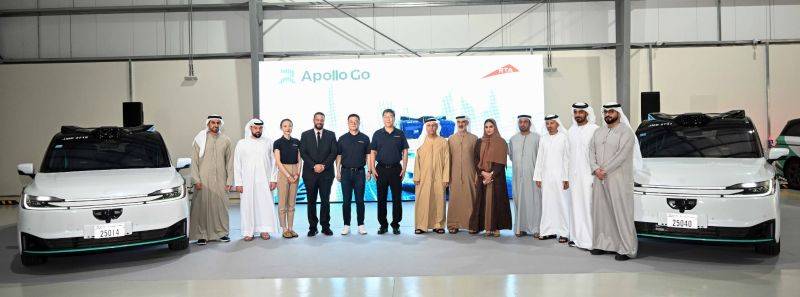
DUBAI has marked a significant step in the development of autonomous transport with the official inauguration of Baidu Apollo Go’s Autonomous Vehicles Operations and Control Centre, the first such facility operated by the company outside China.
The centre was launched by Mattar Al Tayer, Director General and Chairman of the Board of Executive Directors of Dubai’s Roads and Transport Authority, alongside Yunpeng Wang, Corporate Vice President of Baidu and President of Baidu’s Intelligent Driving Group. Located at Dubai Science Park, the facility forms the backbone of Apollo Go’s planned commercial autonomous ride-hailing services in the emirate.
Spanning approximately 2,000 square metres, the centre has been designed as a fully integrated hub to manage autonomous vehicle operations, digital infrastructure and real-time decision-making. It houses a command-and-control centre, simulation and training rooms, and an operations and maintenance unit. Commercial operations of Baidu Apollo Go’s driverless taxis are scheduled to begin in the first quarter of 2026, with the fleet expected to scale progressively to 1,000 vehicles in the coming years.
Integrated operations
The newly opened centre plays a central role in the daily management of autonomous vehicles operating on Dubai’s roads. It is responsible for vehicle dispatch, monitoring and supervision, alongside routine inspection, maintenance and charging operations. The facility also oversees software updates, component testing and the upkeep of specialised equipment dedicated to autonomous vehicle trials.
Designed to integrate intelligent road infrastructure with vehicle systems, the centre supports real-time communication between vehicles and control teams. This allows for rapid response to operational commands and potential incidents, while maintaining continuous oversight of vehicle performance and safety parameters. Simulation and training rooms within the complex enable scenario testing and staff preparation, ensuring operational readiness as services expand.
The centre also supports the work of safety drivers and operational staff across multiple functions, including test readiness, safety awareness, training programmes, inventory management for devices and equipment, and support for day-to-day office operations. These capabilities are intended to ensure a structured transition from trial phases to fully commercial services.
Regulatory milestones
The launch of the operations and control centre follows a series of regulatory and operational milestones between Dubai’s Roads and Transport Authority and Baidu Apollo Go. In March 2025, the two parties signed a Memorandum of Understanding to enable the large-scale operation of autonomous taxis across the emirate. This agreement laid the groundwork for testing, regulation and future commercial deployment.
In July 2025, RTA granted Baidu Apollo Go Dubai’s first autonomous driving trial permit, authorising the company to conduct operational trials of autonomous vehicles on designated public roads. This was followed in August by the start of road trials involving 50 RT6 autonomous vehicles operating in specific areas of Dubai.
More recently, RTA issued the emirate’s first permit allowing fully autonomous vehicles to operate without a safety driver behind the wheel. This approval represents a pivotal step towards the introduction of a fully driverless commercial ride-hailing service and positions Dubai among a small group of cities globally to permit such operations on public roads.
Smart mobility strategy
Speaking during the inauguration, Mattar Al Tayer described the opening of the centre as a strategic milestone in Dubai’s journey towards global leadership in smart mobility and the use of artificial intelligence in transport. He noted that the establishment of Apollo Go’s first operations centre outside China reflects strong confidence among leading global technology companies in Dubai’s regulatory environment and advanced infrastructure.
According to Al Tayer, the issuance of Dubai’s first permit for fully driverless operational trials demonstrates RTA’s commitment to developing a flexible and secure legislative framework that keeps pace with rapid advancements in mobility technologies. He highlighted that the framework is designed to support innovation while ensuring the highest standards of safety and efficiency.

The collaboration with Baidu Apollo Go aligns with RTA’s broader vision to expand future mobility solutions and accelerate the deployment of autonomous vehicles across taxi and ride-hailing services. These efforts form part of Dubai’s long-term transport strategy, which aims to enhance road safety, reduce carbon emissions and improve the overall efficiency of the transport network.
Al Tayer added that RTA continues to work with strategic partners to position Dubai as a global laboratory for future transport technologies, supporting the development of a knowledge-based economy driven by innovation and advanced digital solutions.
Overseas expansion
For Baidu, the Dubai centre represents a key milestone in the international expansion of Apollo Go. Yunpeng Wang said the opening of the first overseas Apollo Go Park, combined with the granting of Dubai’s first driverless vehicle trial permit, underlines the company’s long-term commitment to the United Arab Emirates.
He noted that the collaboration with Dubai’s Roads and Transport Authority builds on Apollo Go’s global expertise in autonomous driving, with a focus on delivering safe, efficient and sustainable ride-hailing services tailored to local requirements. The company plans to work closely with local partners as it prepares for commercial operations in 2026.
Liang Zhang, Managing Director for Europe, the Middle East and Africa at Baidu Apollo, said that receiving Dubai’s first driverless vehicle trial permit reflects the safety and maturity of Apollo Go’s technology. He added that establishing an overseas operations centre in Dubai provides a strong foundation to localise operations and support long-term deployment across the emirate.
Proven track record
Apollo Go’s expansion in Dubai is underpinned by extensive real-world operational experience. Globally, the platform operates in 22 cities and has accumulated more than 240 million km of autonomous driving. Of this total, over 140 million km have been completed in fully driverless mode without a human driver.
The service has also achieved significant scale in terms of usage. Weekly ride volumes have exceeded 250,000 trips, while cumulative completed rides surpassed 17 million as of 31 October 2025. These figures position Apollo Go among the world’s leading providers of autonomous ride-hailing services and provide a data-rich foundation for its international growth.