

Dubai gold eases after June drop as global markets face fresh pressure
Silver retreats as precious metals react to market uncertainty
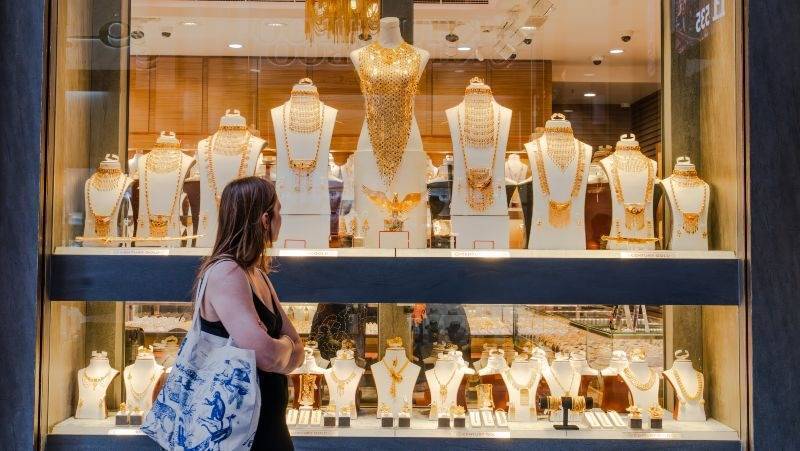
DUBAI – Gold remains one of the most closely watched commodities in Dubai, where jewellery demand and international bullion movements continue to influence daily prices.
The Dubai Jewellery Group’s suggested retail gold jewellery rates provide a key reference point for shoppers and traders across the emirate. On Wednesday, gold prices recorded a slight decline across all categories compared with the previous sessions.
Dubai gold rates
According to the Dubai Jewellery Group, the price of 24K gold stood at Dh479.25 per gram, down from Dh480.25 on Tuesday, and Dh488.00 on Monday. The rate for 22K gold moved to Dh443.75 per gram from Dh444.75 on Tuesday and Dh452.00 on Monday.
The 21K gold rate was listed at Dh425.50 per gram on Wednesday, compared with Dh426.50 a day earlier and Dh433.25 on Monday. Meanwhile, 18K gold was priced at Dh364.75 per gram, lower than Tuesday’s Dh365.50 and Monday’s Dh371.50. The 14K gold rate also declined to Dh284.50 per gram from Dh285.00 on Tuesday and Dh289.75 on Monday.
The movement reflects broader changes in international bullion markets, where gold prices weakened after coming under pressure from stronger US Treasury yields and shifting expectations around the Federal Reserve’s interest rate outlook.
Global market
International gold prices fell on Wednesday after touching a seven-month low in the previous session. Spot gold was down 0.8% at $3,974.01 per ounce as of 0445 GMT, after slipping to $3,942.99 per ounce on Tuesday, its lowest level since last November.
Gold also recorded its largest quarterly decline since 2013 during the second quarter of 2026 and dropped for a fourth consecutive month in June. Market sentiment has been affected by inflation concerns, expectations of tighter monetary policy and uncertainty surrounding geopolitical developments.
The US dollar strengthened against other currencies, making dollar-priced gold more expensive for international buyers. At the same time, higher yields on the benchmark 10-year US Treasury note added further pressure on the non-yielding metal.
Investor focus remained on upcoming US employment data, including June ADP employment figures and nonfarm payroll data, which could influence expectations for the Federal Reserve’s future rate decisions. Markets were also monitoring signals from policymakers, with expectations of a possible September rate increase continuing to support a firmer interest rate outlook.
Geopolitical developments involving the US, Iran and the wider Middle East also remained a factor for commodity markets. Reports that no high-level US-Iran meetings were scheduled reduced hopes of an immediate diplomatic breakthrough, while oil prices moved higher after Iran indicated it would not meet senior US envoys who travelled to the region following recent hostilities.
Concerns around energy markets, inflation risks and the Strait of Hormuz, one of the world’s most important oil transit routes, continued to influence investor attention. Movements in crude prices often affect inflation expectations, which can shape global monetary policy and bullion demand.
Other precious metals
Silver prices also declined alongside gold, with spot silver falling 1.6% to $57.64 per ounce. The metal has faced similar pressure from broader market trends, including currency movements and expectations around interest rates.
Other precious metals followed the downward trend. Spot platinum fell 0.7% to $1,540.25 per ounce after reaching its lowest level since November, while palladium declined 0.6% to $1,197.40 per ounce.