

From Russia to India: How Bahi Ajman Palace, Coral Beach Resort Sharjah are attracting global travellers
At ATM Dubai, Area General Manager Iftikhar Hamdani reveals both hotels are exceeding 95% occupancy
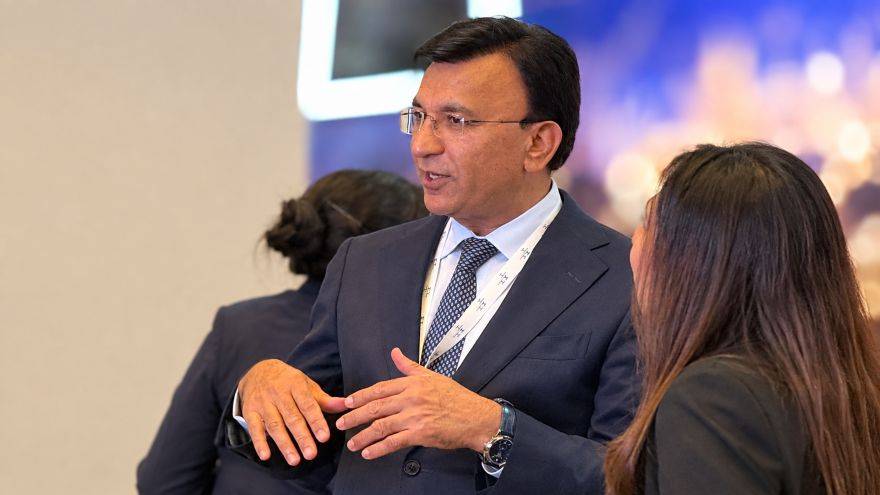
DUBAI – The mood at Arabian Travel Market (ATM) Dubai 2026 is distinctly more energetic than Iftikhar Hamdani had expected. For the Area General Manager overseeing Bahi Ajman Palace Hotel and Coral Beach Resort Sharjah, the crowded halls are not simply a reflection of the scale of the annual travel trade gathering, but a signal of how strongly international tourism is moving through the Northern Emirates. And behind the meetings, networking and destination pitches, his two properties are entering the final quarter with occupancy running at more than 95%.
“We are here at ATM 2026 and I'm so happy to see the crowd, very vibrant crowd. And this is one of the amazing events,” Hamdani said while speaking to TravelsDubai at ATM Dubai 2026.
The event had originally been scheduled for May before being moved to September, but Hamdani said the turnout had exceeded his expectations. “It was a long-awaited event,” he said. “It was supposed to be in May, but happening in September. But seeing the crowd, it's more than expectation.”
For Bahi Ajman Palace and Coral Beach Resort Sharjah, however, the most significant development is taking place beyond the exhibition floor. Hamdani said business on the books for both properties had reached more than 95% occupancy, with the summer driven strongly by staycation demand and the current period increasingly supported by international travellers.
“We had amazing business during the summertime with the staycation,” he said. “And complemented now with the Russian market, with the international long-haul travellers [who] have started in Ajman and Sharjah.”
Making the most of ATM 2026
The shift is particularly visible in the range of nationalities now feeding the two beachfront properties.
Hamdani identified Russia, Belarus, Kazakhstan, wider Central Asia, India and China among the markets showing strong activity, describing international long-haul travellers as increasingly drawn towards Ajman and Sharjah.
“The international long-haul travellers, especially from Russia, Belarus, Kazakhstan, Central Asia, India or China, are flocking into the Northern Emirates and particularly in Sharjah and Ajman,” he said.
The comments underline the increasingly international character of demand for the two properties. Rather than relying exclusively on domestic or short-haul Gulf traffic, the hotels are seeking to deepen relationships with international travel trade partners and broaden their distribution across established and emerging feeder markets.
That is also central to the strategy at ATM 2026.
Bahi Ajman Palace Hotel and Coral Beach Resort Sharjah, both managed by Hospitality Management Holding (HMH), are being represented through a triple-stand presence, engaging visitors through Hospitality Management Holding, the Ajman Tourism, Culture and Media Department and the Sharjah Commerce and Tourism Development Authority. The arrangement gives the hotels access not only to hotel buyers and tour operators but also to the destination-led conversations taking place around Ajman and Sharjah.
The focus is on strengthening business-to-business relationships, developing distribution channels and pursuing agreements with travel trade partners across the GCC, Europe and CIS markets.
For international visitors, the proposition is also closely tied to the character of the two emirates. Both properties combine beachfront accommodation with access to destinations that offer a different pace and setting from Dubai's established tourism circuit.
Bahi Ajman Palace is a five-star beachfront property overlooking the Arabian Gulf, with 254 rooms, suites and serviced residences alongside restaurants, leisure facilities and meeting spaces. The hotel is positioned within easy reach of both Dubai International Airport and Sharjah International Airport.
Coral Beach Resort Sharjah adds another established beachfront base in the Northern Emirates, strengthening HMH's presence in a destination increasingly promoted around its cultural, eco-tourism and leisure experiences.
At ATM, the hotels are therefore selling more than rooms. The proposition is about connecting accommodation with destination experiences, particularly for international travellers looking beyond the most familiar UAE itineraries.
Beyond Dubai
Hamdani's assessment of the current market also points to a wider evolution in traveller behaviour.
International visitors arriving in the UAE have a much broader choice of destinations and hotel experiences than in previous years, while the Northern Emirates are increasingly able to compete by combining beachfront settings, family-oriented hospitality, cultural attractions and comparatively accessible locations.
For Bahi Ajman Palace, the private beachfront setting and family-friendly positioning form a central part of the product. Coral Beach Resort Sharjah similarly brings together beach, leisure, accommodation, dining and events within a destination that has been building its international tourism profile.
The changing source-market mix is particularly important because it creates a more diversified demand base. The Russian market, for example, is arriving alongside travellers from Belarus, Kazakhstan and other Central Asian markets, while India and China remain important long-haul markets for the UAE's wider tourism sector.
Hamdani said the strength of current bookings gives him confidence about the immediate months ahead.
“Both the hotels have amazing business and the occupancy is really very good in September,” he said. “The last quarter looks very healthy.”
The performance follows a period in which staycation demand had provided a substantial summer base. Earlier in 2026, the two properties had also forecast occupancy of around 90% for the Eid Al Adha period amid strong domestic demand.
That combination of domestic, regional and international business is becoming increasingly significant for Northern Emirates hospitality as hotels seek to balance seasonal patterns with a broader year-round source-market mix.
Sustainability in action
If the commercial conversation at ATM is about markets, contracts and occupancy, Hamdani is equally keen to discuss what happens inside the hotels once guests arrive.
Sustainability has become a defining part of the operational strategy at both properties, with the hotels having introduced technologies aimed at reducing waste, water consumption and reliance on single-use materials.
Bahi Ajman Palace previously introduced atmospheric water-generation technology capable of producing up to 365,000 litres of drinking water annually from air humidity. The project was designed to eliminate the need for single-use plastic bottles, with the hotel using reusable glass bottles as part of the system. HMH says the initiative avoids approximately 730,000 plastic bottles from entering waste streams and cuts an estimated 33.58 metric tonnes of carbon emissions annually.
Coral Beach Resort Sharjah has now taken the approach a step further with food waste.
The resort commissioned what has been described as Sharjah's first hotel biodigester, processing organic kitchen waste on site and converting it into nutrient-rich greywater for use in landscaped areas. The initiative forms part of the Sharjah Commerce and Tourism Development Authority's Food Waste Carbon Pilot Implementation.
For Hamdani, the significance lies in making sustainability measurable rather than treating it simply as a branding exercise.
“At Bahi Ajman Palace and Coral Beach Resort Sharjah, we are always leading to introduce new initiatives, new technologies,” he said.
The hotels had previously used atmospheric water generation and an on-site glass-bottle operation to reduce dependence on conventional bottled water. The latest initiative at Coral Beach Resort Sharjah addresses another major hospitality challenge: food waste.
“And now the new initiative we have launched in Coral Beach Resort Sharjah, and that is biodigester,” Hamdani said.
He said the system is processing around 300kg of waste every day that would otherwise have gone to landfill.
“With this digester machine, every day 300kg waste is no more going on a landfill,” he said. “And we are making this 300kg waste into grey water, which is a nutrient water which is food for our plants.”
The closed-loop approach means waste generated in the resort's kitchens can ultimately contribute to maintaining its landscaped areas. Independent reporting on the project confirms that the resulting greywater is being reused for irrigation and that the biodigester is intended to reduce landfill disposal, methane emissions and the carbon associated with transporting food waste.
The initiative also fits into a wider sustainability programme at Coral Beach Resort Sharjah, which includes its on-site water bottling operation, the Coralganic organic garden and measures aimed at reducing energy, water and other forms of waste.
A wider green network
Hamdani's ambitions for sustainability extend beyond the two hotels themselves.
The biodigester project is part of a broader relationship with Sharjah's tourism authorities, and Hamdani said the hotel is participating in Sustain Sharjah while describing the biodigester as a pilot project linked to Sharjah tourism.
“Our wish is to get actually more hotels to join our initiative and our club,” he said.
That collaborative approach has gained additional relevance this year with the launch of the Emirates Hospitality Sustainability Alliance (EHSA) at Coral Beach Resort Sharjah.
Launched by the Emirates Environmental Group in September 2026, EHSA brings together hospitality leaders, sustainability professionals and industry stakeholders to share expertise and pursue measurable environmental action. Its areas of focus include energy and water consumption, waste and food waste, procurement, supply chains, resource efficiency and consumer behaviour.
For hotels, the importance of such cooperation is increasingly practical. Sustainability measures can require capital expenditure and operational changes, but technologies such as food-waste tracking, water generation and biodigesters can also affect consumption, disposal and operating costs.
Hamdani has previously spoken about the commercial dimension of such measures. In an interview earlier this year, he said the properties' efforts around kitchen waste, electricity and water had contributed to a reduction of almost 30% in utility bills compared with the previous year.
That makes sustainability a particularly relevant part of the ATM conversation, where buyers and hotel operators are increasingly discussing not only the guest proposition but also the operational credentials behind it.
Beyond sales exercise
At ATM 2026, Hamdani's immediate priority remains firmly commercial. The three-stand presence provides the hotels with multiple touchpoints for meetings with international travel companies, while the destination presence allows the properties to position their hotel offerings within the broader Ajman and Sharjah tourism story.
The objective is to establish new relationships, strengthen existing distribution networks and identify partners capable of generating business from international leisure markets.
For Hamdani, the strong September performance provides a useful backdrop to those discussions.
“Both the hotels have amazing business and the occupancy is really very good in September,” he said, while pointing to the growing contribution from Russia, Belarus, Kazakhstan, Central Asia, India and China.
The distinction between domestic staycation business and international leisure demand is becoming particularly important – the former helped maintain momentum through the summer, while the latter is now providing additional depth as the high season approaches.
That is reflected in Hamdani's assessment of the final quarter. “I hope that the business is coming really strong in the last quarter, not only for the Northern Emirates, but overall in the UAE,” he said.
For the two hotels, the ATM agenda therefore extends well beyond a conventional hotel sales exercise. It brings together a strong current occupancy position, a widening international source-market base, destination-led promotion and a sustainability programme increasingly built around measurable operational changes.