

UAE-India travel: Check latest flights schedule amid limited Air India operations
Rising jet fuel prices trigger revised passenger surcharges

DUBAI – Air travel between the United Arab Emirates (UAE) and India continues to face disruption, with Air India and Air India Express maintaining limited connectivity through a mix of ad hoc and scheduled operations today (Friday).
The revised flight schedule reflects ongoing operational constraints across West Asia, while a parallel increase in fuel surcharges underscores the mounting pressure from surging global jet fuel prices.
Passengers travelling on UAE-India routes are advised to closely monitor flight availability, as most services are no longer operating on fixed schedules. The airline group has stated that all flights remain subject to slot approvals and prevailing conditions at departure airports, resulting in reduced predictability for travellers.
UAE routes
Across the UAE, scheduled Air India services remain suspended, with flights operating largely on an ad hoc basis. In Dubai, there are no scheduled departures, but limited services are being run as required. Air India is operating flights to Delhi, while Air India Express is connecting passengers to Mangaluru through ad hoc operations.
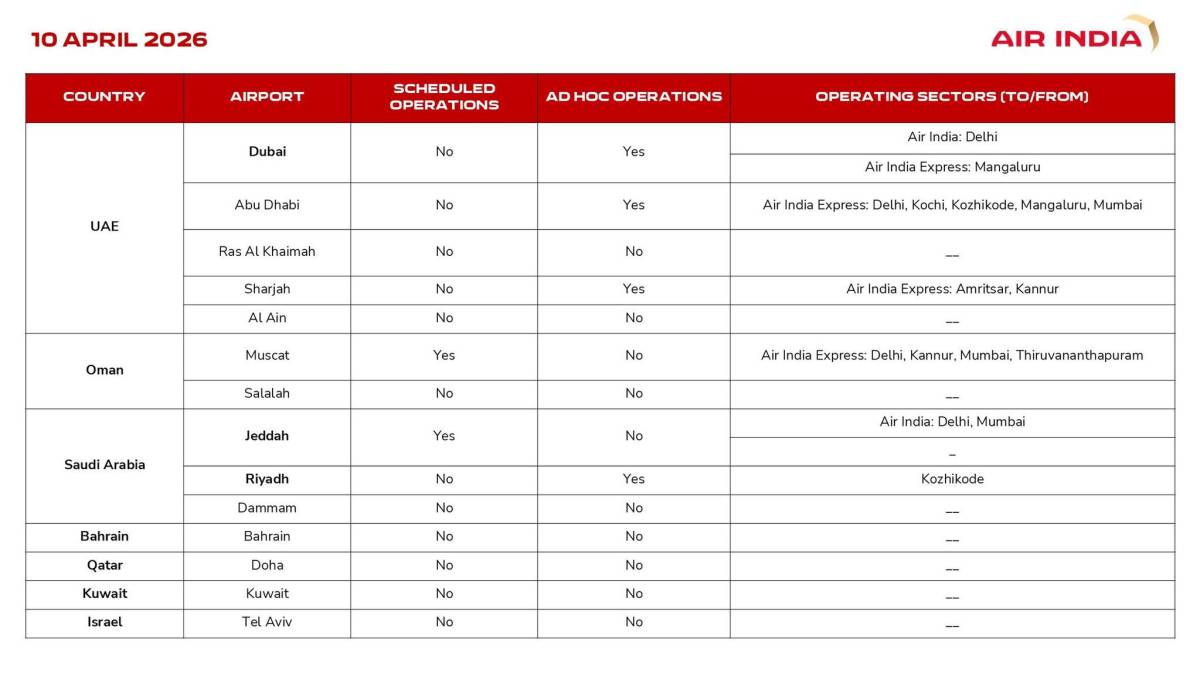
Abu Dhabi is witnessing a similar pattern, with no scheduled services in place. However, Air India Express continues to operate multiple ad hoc flights linking the UAE capital with key Indian cities, including Delhi, Kochi, Kozhikode, Mangaluru, and Mumbai. These routes provide essential connectivity, though without the consistency of fixed timetables.
In Sharjah, ad hoc flights are available to Amritsar and Kannur through Air India Express, while Ras Al Khaimah currently has no flight activity. Al Ain also remains without both scheduled and ad hoc operations.
The absence of regular scheduling across major UAE airports highlights a significant shift in airline operations, with capacity being managed dynamically based on demand, operational feasibility, and external constraints.
Regional network
Beyond the UAE, Air India’s West Asia network presents a mixed operational picture. Oman’s Muscat continues to see stable scheduled services, with Air India Express operating flights to Delhi, Kannur, Mumbai, and Thiruvananthapuram. Salalah, however, remains without active operations.
In Saudi Arabia, Jeddah retains scheduled connectivity, with Air India operating flights to Delhi and Mumbai. Meanwhile, Air India Express maintains services to Kozhikode and Mangaluru. Riyadh, which previously had no operations, now sees limited ad hoc connectivity to Kozhikode, signalling a partial restoration of services.
Other regional destinations remain largely suspended. There are no flights operating to Bahrain, Doha, Kuwait, or Tel Aviv, reflecting a broader contraction in scheduled international services across parts of West Asia.
This uneven distribution of flights indicates that airlines are prioritising select high-demand routes while scaling back operations in markets facing logistical or commercial challenges.
Fuel impact
The changes in flight operations come against the backdrop of a sharp rise in global jet fuel prices, which has significantly impacted airline costs worldwide. According to data from the International Air Transport Association, the average jet fuel price surged to $195.19 per barrel for the week ending March 27, nearly doubling from $99.40 at the end of February.
In addition to crude oil price increases, refinery margins have also escalated rapidly. The crack spread rose from $27.83 per barrel in late February to $81.44 within three weeks, adding further strain on airline operating expenses.
In response, Air India has revised its fuel surcharge structure effective April 8 for most routes, with additional changes for long-haul destinations taking effect from April 10. For passengers travelling between India and the West Asia region, including UAE routes, the fuel surcharge has been set at $50 per passenger per sector.
The airline has indicated that these surcharges only partially offset the increase in fuel costs, with a substantial portion still being absorbed internally.
For domestic flights within India, a new distance-based surcharge system has replaced the earlier flat rate. Passengers will now pay between INR 299 and INR 899 depending on the length of their journey, following a government decision to cap increases in aviation turbine fuel prices.
On international routes beyond West Asia, surcharges are significantly higher. Flights to Europe, including the United Kingdom, now carry a surcharge of $205 per sector, while travel to North America and Australia attracts a surcharge of $280.
The revised surcharge structure applies to tickets issued after the specified effective times. Tickets purchased earlier will not be affected unless passengers make changes that require fare recalculation.
Air India has stated that it will continue to review its surcharge levels periodically, depending on fuel price trends and broader market conditions, as airlines navigate one of the most volatile cost environments in recent years.