

UAE weather turns dramatic as Sharjah sees heavy rain while mercury hits 50.9°C
Light showers could return across northern and eastern areas from Friday night
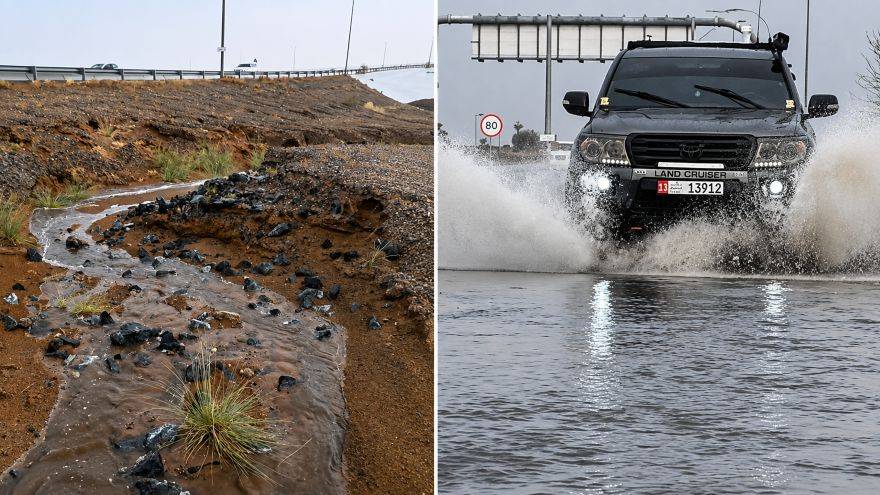
DUBAI/SHARJAH – The United Arab Emirates (UAE) experienced a striking contrast in weather on Thursday, with thunderstorms and heavy rain affecting parts of Sharjah while temperatures climbed to 50.9°C in two inland locations.
Heavy rainfall was reported around Maliha Road in Sharjah's central region, while thundery showers also moved across Madam and areas to its west. At the same time, the country's highest temperature reached 50.9°C at Al Faqa in the Al Ain region and Madinat Zayed in the Al Dhafra Region.
The rain brought a brief change to conditions in parts of Sharjah after an exceptionally hot afternoon. Along the East Coast, clouds developed during the day, with intermittent drizzle reported in some areas. The contrasting conditions reflect the weather patterns often seen across the UAE during August, when intense surface heating combines with moisture moving in from the east to trigger cloud development and rainfall.
The National Centre of Meteorology (NCM) expects the possibility of further light rainfall over northern and eastern parts of the country from Friday night, with partly cloudy skies and periods of increased humidity also forecast over the weekend.
Scorching heat
The UAE's highest temperature on Thursday was recorded at 50.9°C in Al Faqa, Al Ain, at 1.30pm, according to the NCM. The same temperature was later recorded in Madinat Zayed in the Al Dhafra Region at 2.45pm, highlighting the intensity of the summer heat across inland areas.
The highest temperature recorded over the country today is 50.9°C in Al Faqa (Al Ain) at 13:30 and in Madinat Zayed (Al Dhafra Region) at 14:45 UAE Local time. pic.twitter.com/xQqCr6hEhK
— المركز الوطني للأرصاد (@ncmuae) August 13, 2026
The extreme reading came as daytime heating remained particularly strong across the country's interior. Despite the intense heat, atmospheric moisture helped generate convective clouds in parts of the country, particularly around the eastern and central areas.
The development of these clouds is common during the UAE's summer months. Moist air moving inland can interact with strong daytime heating, encouraging towering clouds that may produce showers and thunderstorms over localised areas.
The contrast was particularly noticeable in Sharjah, where rain and thunderstorms developed while other parts of the UAE remained under severe heat.
Rain returns
Storm activity was reported over the Maliha area in central Sharjah on Thursday afternoon, with heavy rain affecting parts of the road network. Thundery showers were also observed around Madam and areas to its west.
الإمارات : هطول أمطار الخير على المدام في المنطقة الوسطى للشارقة #أخبار_الإمارات #مركز_العاصفة
— مركز العاصفة (@Storm_centre) August 13, 2026
13/08/2026 pic.twitter.com/hoLxpqDXZL
Cloud formation was also reported along the country's East Coast, accompanied by intermittent drizzle in some locations. Such conditions can develop when moist southeasterly air flows interact with the country's mountainous terrain and intense summer heating.
The NCM's forecast points to another opportunity for rain as the weekend approaches. On Friday, August 14, weather is expected to remain fair to partly cloudy at times, before becoming cloudy over northern and eastern areas by night and into Saturday morning, with a chance of light rain.
Winds are expected to be light to moderate, initially from the southeast before shifting northwesterly. They will blow at 10 to 20km/h, occasionally reaching 35km/h. Seas are forecast to remain slight in both the Arabian Gulf and the Sea of Oman.
Road caution
The rainfall also prompted attention to road conditions, particularly around central and eastern areas where showers can quickly reduce visibility and leave water on roads.
Motorists travelling through areas affected by rain are advised to drive carefully, maintain safe distances and remain alert to changing road conditions. Mountain roads and routes near wadis require particular caution during and after heavy rainfall because sudden water flow can develop in low-lying areas.
Reduced visibility may also become a factor during periods of rain and, later in the weekend, with possible early-morning mist along coastal areas.
The NCM's outlook suggests that the weather will remain largely fair to partly cloudy across the country, punctuated by localised cloud build-up and possible light rainfall over northern and eastern areas. Meanwhile, inland temperatures are expected to remain high as the UAE moves through the final weeks of its traditional peak summer season.
Weekend outlook
On Saturday, August 15, fair to partly cloudy weather is expected, with humidity increasing during the night and into Sunday morning over some coastal areas. The NCM has also indicated a possibility of mist formation.
Southeasterly winds will again shift northwesterly, with speeds of 10 to 20km/h and gusts reaching 35km/h. Sea conditions are expected to remain slight.
On Sunday, August 16, skies are expected to be partly cloudy to cloudy at times over some northern and eastern areas, where light rainfall could occur.
Coastal areas are likely to become humid during the night and into Monday morning, with mist formation possible. Winds will be light to moderate, moving from southwesterly to northwesterly directions at 10 to 20km/h, occasionally reaching 30km/h.
The forecast indicates that the most notable changes over the coming days will centre on cloud development, isolated rainfall, humidity and visibility rather than a broad spell of wet weather across the country.
When will summer end?
The UAE remains firmly within its peak summer period, when temperatures can remain exceptionally high even as localised convective activity produces rain in other areas. The country's traditional seasonal calendar has also entered its final phase of peak summer. The rising of the Al Kulaybin star on August 11 marked the beginning of Marakhiyat Al Qalaid, regarded in traditional Arabian astronomy as the closing period of Al Qayz, the hottest part of the year.
Ibrahim Al Jarwan, Chairman of the Emirates Astronomical Society and a member of the Arab Union for Astronomy and Space Sciences, said the period runs from August 11 to September 3.
The next traditional seasonal marker will come on August 24, when Suhail, or Canopus, is expected to become visible before dawn in the south-eastern sky. The star has traditionally been associated with the gradual retreat of summer heat and the eventual arrival of cooler nights.
However, the appearance of Suhail does not mark the immediate end of summer. The astronomical autumn begins with the autumnal equinox on September 23, while the UAE can continue experiencing high temperatures and humidity well into the transition period.