

Dubai expands pedestrian network with 6 new bridges
RTA plans 23 more bridges by 2030
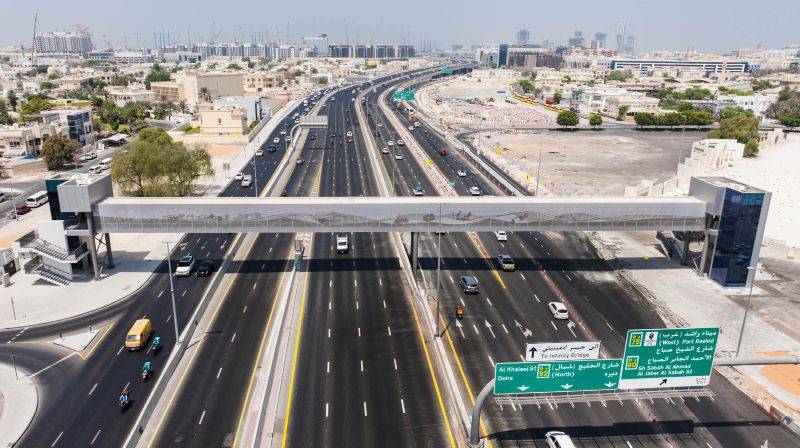
DUBAI’s Roads and Transport Authority (RTA) has completed two major pedestrian bridges on Sheikh Rashid Street and Al Mina Street as part of the Al Shindagha Corridor Improvement Project.
These structures form part of a wider initiative to deliver six new pedestrian and cyclist bridges across key streets in the emirate, with five scheduled to open before the end of this year and one set for completion in early 2027.
The programme underscores Dubai’s long-term ambition to create a pedestrian and cyclist-friendly city. Since 2006, the number of pedestrian bridges and underpasses in the emirate has soared from 26 to 177 by the end of 2024, a 581% increase. RTA has now set its sights on constructing 23 additional bridges by 2030, guided by field studies that account for population density, land use, tourism hubs, economic attractions, and public transport stations.
هيئة الطرق والمواصلات في دبي تنجز جسرين للمشاة على شارعي الشيخ راشد والميناء، ضمن أعمال مشروع تطوير محور الشندغة، وتنفذ حالياً ستة جسور للمشاة والدراجات في عدد من الشوارع الحيوية في إمارة دبي، وسيجري افتتاح خمسة جسور قبل نهاية العام الجاري، بينما سيفتتح الجسر السادس في الربع… pic.twitter.com/1goqWXYLnX
— Dubai Media Office (@DXBMediaOffice) September 14, 2025
Safety and growth
Mattar Al Tayer, Director General and Chairman of the Board of Executive Directors of RTA, highlighted the role of pedestrian bridges in enhancing road safety and improving quality of life. He confirmed that fatalities involving pedestrians had dropped by 97% between 2007 and 2024, falling from 9.5 deaths per 100,000 people to just 0.3.
The development of new crossings has also translated into growing satisfaction among residents, with surveys showing that 88% of Dubai’s population are now content with pedestrian infrastructure. Alongside this, pedestrian trips rose from 307 million in 2023 to 326 million in 2024, a 6% increase. Cycling trips also experienced a 5% rise, climbing from 44 million in 2023 to 46.6 million last year.
Zero fatalities target
Al Tayer emphasised that pedestrian safety is central to Dubai’s Traffic Safety Strategy, which aims for Zero Fatalities and seeks to position Dubai among the world’s safest cities in road mobility.
The newly constructed bridges reflect international standards of design and safety. They are fitted with electromechanical systems, fire alarms, firefighting units, and remote monitoring. Some are further equipped with dedicated cycling tracks, e-scooter lanes, and bike racks. Aesthetic and creative elements have also been incorporated into the bridges, ensuring they blend with surrounding architecture and urban landscapes.
Completed bridges
The bridge on Sheikh Rashid Street measures 91 metres in length, 3.4 metres in width, and 6.5 metres in height, while the Al Mina Street bridge extends 109 metres in length with identical width and height dimensions. Both structures feature lifts, staircases, and advanced system rooms to ensure user safety and convenience.
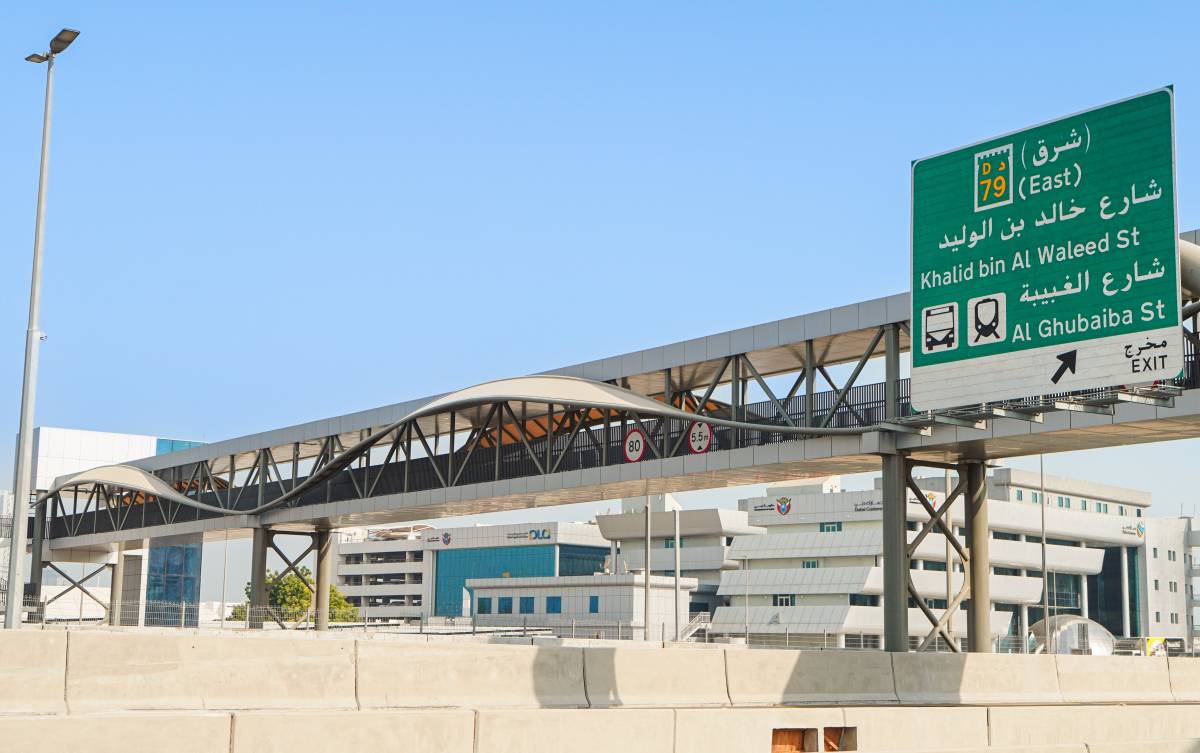
These projects form part of the Al Shindagha Corridor Improvement Project, a large-scale scheme designed to ease traffic flow across one of Dubai’s busiest districts.
Bridges nearing completion
Among the six bridges constructed, five are scheduled to open before the end of this year. Two of the most prominent are located on Sheikh Zayed Road and Al Khail Road, offering strategic links for pedestrians, cyclists, and e-scooter users between Al Sufouh, Dubai Internet City, Al Barsha Heights, Al Barsha 3, and Dubai Hills.
The Sheikh Zayed Road bridge extends 528 metres, while the Al Khail Road bridge spans 501 metres. Each is five metres wide, accommodating a three-metre track for cyclists and e-scooters alongside a two-metre pedestrian walkway.
Architecturally, the Sheikh Zayed Road bridge symbolises connectivity with interwoven lines and an open structure offering sweeping views of nearby towers. The Al Khail Road bridge takes inspiration from sun rays, with a design aimed at creating a serene environment away from street noise while considering the sun’s trajectory in its structure.
Creative Zone link
The third bridge is situated on Al Manara Street in the Al Quoz Creative Zone. Measuring 45 metres in length and 5.5 metres in width, it is designed to support smooth pedestrian and cyclist movement in an area renowned for cultural and artistic activity. Two ramps, each 210 metres long, ensure accessibility and flow. Its design complements the architectural character of the district.
Large crossings
Two further large-scale bridges are expected to open before year-end. The first, spanning Sheikh Mohammed bin Zayed Road at its intersection with Tunis Street in Al Nahda, stretches 554 metres with a width of 5.6 metres and stands 12.5 metres above the busy road. It connects Muhaisnah 1 with Al Twar and extends towards Al Mamzar Beach.

The second is located on the Dubai–Al Ain Road, linking Wadi Al Safa 4 (Liwan) with Nadd Hessa near Dubai Silicon Oasis. At 730 metres in length and 5.6 metres in width, it rises 7.8 metres above the roadway, providing a vital crossing point for one of Dubai’s most travelled highways.
Future bridge
The sixth bridge is currently being built as part of the Future Street Improvement Project on Al Sukook Street, located in Dubai’s Central Business District. It measures 44 metres in length, 4.6 metres in width, and 6.5 metres in height. The bridge includes lifts, staircases, and advanced system rooms and is expected to be completed in the first quarter of 2027. Its design is intended to harmonise with the city’s urban fabric while providing practical connectivity.
Expansion plans
Looking beyond 2027, RTA has announced plans for nine more pedestrian bridges to be completed by 2028. These include crossings near Coca-Cola Arena, in Business Bay, and on Sheikh Zayed Road close to the Burj Khalifa area. Additionally, six bridges will be built on Al Asayel Street, enhancing access in one of Dubai’s busiest corridors.