

World record shattered as humanoid robot outruns humans in Beijing half marathon 2026
Autonomous navigation powers breakthrough performance on complex course
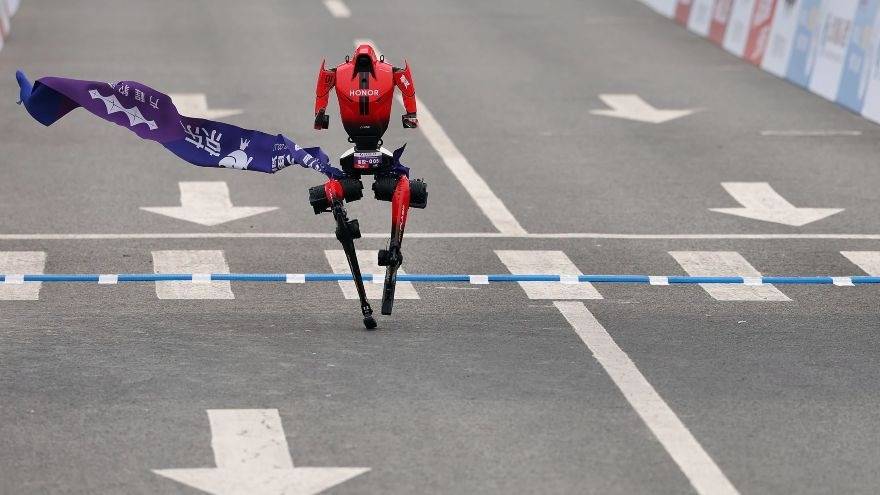
DUBAI/BEIJING – The streets of Beijing’s E-Town district turned into a stage for technological history on Sunday as humanoid robots lined up alongside human runners, delivering a performance that redefined the limits of both sport and engineering.
In a landmark moment, a Chinese-developed robot surged ahead to clock a time faster than the human half-marathon world record.
The 2026 Beijing E-Town Half-Marathon and Humanoid Robot Half-Marathon drew more than 300 robotic participants alongside thousands of human runners, blending athletic endurance with cutting-edge artificial intelligence. What began as an experimental showcase has rapidly evolved into a high-performance proving ground for real-world robotics applications.
Record run
At the centre of attention was “Lightning”, an autonomous humanoid robot developed by Chinese technology firm Honor. It completed the 21-kilometre course in 50 minutes and 26 seconds, surpassing the human world record of approximately 57 minutes set by Ugandan runner Jacob Kiplimo earlier this year in Lisbon.
48 mins and 19 secs! The humanoid robot named #Lightening, made by Chinese firm #Honor, has won the robot half-marathon title ???? https://t.co/MAE648KWfG pic.twitter.com/dFaoKH4oSI
— ShanghaiEye????official (@ShanghaiEye) April 19, 2026
Despite a minor stumble near the finish line, the robot maintained its pace, averaging roughly 25 kilometres per hour. Under the event’s scoring system, which prioritises autonomous navigation, Lightning secured the official title ahead of faster but remotely controlled entries.
Another Honor robot reportedly crossed the finish line in 48 minutes and 19 seconds but did not qualify for the championship due to its reliance on remote operation. Runner-up autonomous machines completed the race in approximately 51 and 53 minutes, further highlighting the narrowing gap between mechanical and human performance.
Tech leap
The race marked a dramatic improvement from the inaugural event in 2025, when the fastest robot required more than two hours and 40 minutes to complete the same distance. This year’s competition showcased not only faster speeds but also significant advancements in autonomy.
Around 40 percent of the participating robots operated without remote control, demonstrating capabilities such as real-time localisation, obstacle avoidance and path planning. The course itself featured more than 10 terrain variations, including slopes, curves and narrow pathways, designed to test navigation precision under dynamic conditions.
Supporting this performance was a sophisticated technological backbone. High-precision positioning powered by China’s BeiDou Navigation Satellite System enabled centimetre-level accuracy for many teams, while a 5G-Advanced communication network delivered near-instant data exchange with minimal latency.
Engineers pointed to innovations such as integrated joint modules capable of delivering peak torque of 400 Nm and advanced liquid-cooling systems that regulate heat during high-load operation. These features allow humanoid robots to sustain prolonged physical activity without performance degradation.
LIVE: 2nd Humanoid Robot Half-Marathon kicks off Sunday in Beijing, gathering over 300 bots, including a #Unitree robot's debut ????️ https://t.co/5Rwh6G0Bm8
— ShanghaiEye????official (@ShanghaiEye) April 18, 2026
Beyond the spectacle, the event reflected broader shifts within China’s robotics landscape. According to research firm Omdia, global shipments of humanoid robots reached 13,000 units in 2025, with China accounting for 90 percent of the total. Domestic companies dominated the top tier of global suppliers, supported by an extensive manufacturing ecosystem.
Industry insiders estimate that developing a humanoid robot in manufacturing hubs such as Shenzhen can cost as little as 2 million yuan ($282,000), a figure that highlights the accessibility of innovation within the sector. The availability of core components, including frameless torque motors and harmonic reducers, has further lowered barriers to entry.
Investment momentum continues to build, with funding in robotics and embodied artificial intelligence reaching 73.5 billion yuan ($10.8 billion) in 2025. Government-backed initiatives, including open-source platforms, dataset standardisation and targeted investment funds, are accelerating the transition from laboratory prototypes to real-world deployment.
Beijing half marathon
The Beijing event also celebrated the convergence of sport and technology through its design and symbolism. Newly unveiled trophies for the 2026 race reflect the theme “Human and Robotics Running Together, Striving to Lead”, capturing the shared stage between human athletes and machines.

With minimalist forms inspired by motion and finished in metallic textures, the trophies embody the fusion of athletic achievement and technological progress. Separate designs for male, female and robot winners highlight the inclusive vision of the event, where human and machine performances are recognised side by side.
Spectators lining the course witnessed robots navigating the route with varying degrees of agility. Some displayed fluid, near-human strides, while others moved more mechanically, revealing the diversity of approaches among competing teams. A robot acting as a traffic marshal added to the spectacle, directing participants through gestures and voice commands.
As the race unfolded, the emphasis moved beyond whether robots could complete the distance to how quickly they could do so. The Beijing half marathon has become a testing ground where innovation is measured not only in laboratory metrics but in real-world endurance, speed and reliability, with each stride marking a new phase in the evolution of humanoid robotics.