

Iran-Israel tensions ground flights as Emirates, PIA and global airlines suspend services
Gulf routes heavily affected by precautionary airspace restrictions
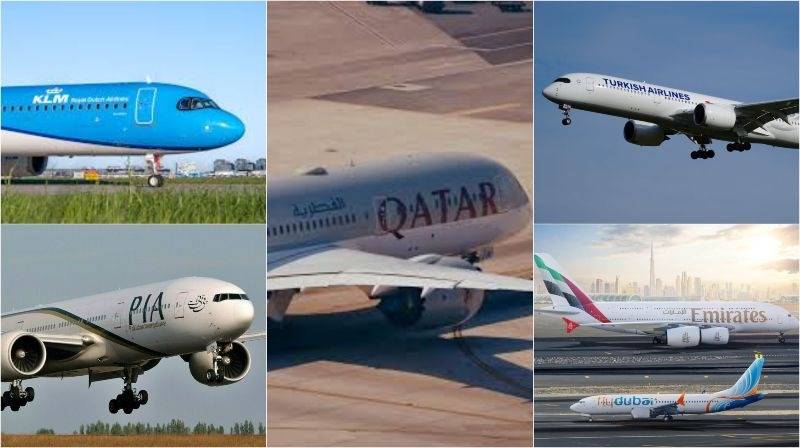
DUBAI – Escalating tensions between Israel and Iran triggered widespread disruption to international aviation on Saturday, forcing airlines around the world to suspend, cancel or reroute flights across the Middle East.
Major carriers moved quickly to prioritise passenger safety as multiple countries restricted or closed their airspace. The ripple effect has impacted key hubs in the Gulf, Europe and Asia, with airlines closely monitoring the rapidly evolving situation.
Flight-tracking data from Flightradar24 showed that airspace over Iran and Iraq was largely empty on Saturday morning, underlining the scale of the disruption. Authorities and airlines said operational decisions remain under continuous review.
Flight suspensions
Air France cancelled flights to and from Tel Aviv and Beirut for Saturday, while KLM brought forward the suspension of its Amsterdam-Tel Aviv service, cancelling the only flight scheduled for the day.
Japan Airlines halted its Tokyo Haneda-Doha service on Saturday and cancelled the return flight planned for March 1. Germany’s Lufthansa suspended flights to and from Tel Aviv, Beirut and Amman until March 7, and also paused services to Dubai over the weekend. The airline confirmed it would avoid the airspace of Israel, Lebanon, Jordan, Iraq and Iran until at least the same date.
Low-cost carrier Wizz Air stopped flights to and from Israel, Dubai, Abu Dhabi and Amman with immediate effect until March 7, adding that schedules could change as the situation develops.
Virgin Atlantic said it would avoid Iraqi airspace and cancelled its VS400 service from London Heathrow to Dubai on Saturday. Iberia Express also cancelled its Tel Aviv flights, while Norwegian Air temporarily halted all Dubai services.
UAE operations disrupted
Dubai’s aviation sector experienced significant disruption as Emirates and flydubai temporarily suspended operations following regional airspace closures and rising tensions. Authorities said the measures were precautionary and aimed at ensuring safety.
Emirates confirmed it is closely monitoring developments and coordinating with relevant authorities. The airline apologised for the disruption and said affected customers are being supported with rebooking, refunds or alternative arrangements.
Flydubai earlier announced it would halt all operations on February 28 due to the same restrictions.
Across the UAE, major airports issued urgent passenger advisories. Dubai Airports urged travellers to verify flight status before heading to Dubai International or Al Maktoum International. Sharjah Airport warned of cancellations and delays, while Abu Dhabi Airports said some services at Zayed International Airport could face disruption.
PIA and regional airlines
Pakistan International Airlines suspended flights to the UAE, Bahrain, Kuwait and Doha until at least Saturday evening or until airspace reopens. The airline said Saudi Arabia services would continue but on longer rerouted paths using Boeing 777 aircraft.
⚠️⛔️⚠️
— PIA (@Official_PIA) February 28, 2026
In view of the developing situation in the Middle East, #PIA is suspending its flights to #UAE ????????, #Bahrain????????, #Kuwait???????? and #Doha ???????? till tomorrow evening, or till opening of respective airspaces.
Flights to #KSA ???????? have been rerouted, avoiding conflict hit zones.…
PIA urged passengers to contact its call centre for updated information or re-accommodation. The airline said further decisions on restoring operations would depend on the evolving regional situation.
Elsewhere, Turkish Airlines cancelled flights to several Gulf destinations including Qatar, Kuwait, Bahrain, the UAE and Oman. A Polish airline diverted its Warsaw–Dubai flight mid-journey.
Qatar Airways also temporarily halted some Doha services due to airspace closures, according to regional reports.
Travel advisories issued
Saudi aviation authorities released travel alerts after the regional airspace disruption, urging passengers to check directly with airlines before travelling to the airport. Similar advisories were issued by major Saudi hubs including King Khalid International Airport in Riyadh, as well as airports in Jeddah and Dammam.
Emirates separately warned that its contact centre is experiencing unusually high call volumes and advised passengers whose travel is not urgent to check flight status online.
Airlines across the Gulf and beyond continue to adjust schedules in real time as governments assess security risks and coordinate with aviation regulators. The fast-moving situation has created uncertainty for travellers across multiple continents, with further operational changes possible.