

UAE-Australia travel: Emirates boosts Adelaide links with first A350 long-range service
New aircraft expands Premium Economy access

DUBAI – Emirates has introduced its first ultra-long-range Airbus A350 to Adelaide, a move that completes the rollout of the carrier’s Premium Economy cabin across all five Australian gateways and marks a fresh phase in UAE-Australia connectivity.
The A350-900ULR entered service to Adelaide on 1 December 2025, replacing the Boeing 777-200LR on EK440/441 and delivering an expanded product offering that includes 28 Premium Economy seats on every rotation. The arrival of the new aircraft in Adelaide follows a ceremonial water-cannon salute and an official welcome by South Australian tourism and airport officials, underscoring the significance the airline attaches to the state capital.
The aircraft substitution also forms part of a wider fleet and product strategy in Australia. Across Emirates’ Australian network, a total of 56 out of 70 weekly return services between Australia and Dubai are now operated by the airline’s next-generation aircraft. That mix comprises the four-class A380 across multiple cities, the four-class Boeing 777 from Melbourne, and the newly introduced long-range A350 in Adelaide. The combined effect is the introduction of more than 5,000 weekly Premium Economy seats between Australia and Dubai, providing passengers in every city served by Emirates with access to the carrier’s latest generation cabin products.
What’s new
The change in equipment and cabin offering is operational as much as it is experiential. EK440 departs Dubai at 02:00 local time and arrives in Adelaide at 20:50 local time, while the return service, EK441, departs Adelaide at 22:50 and arrives back in Dubai at 05:20 the next day. These timings reflect the long-range capability and scheduling considerations for an ultra-long-range aircraft, enabling the airline to offer the Adelaide market improved seat choice and enhanced onboard technology while maintaining daily connectivity.
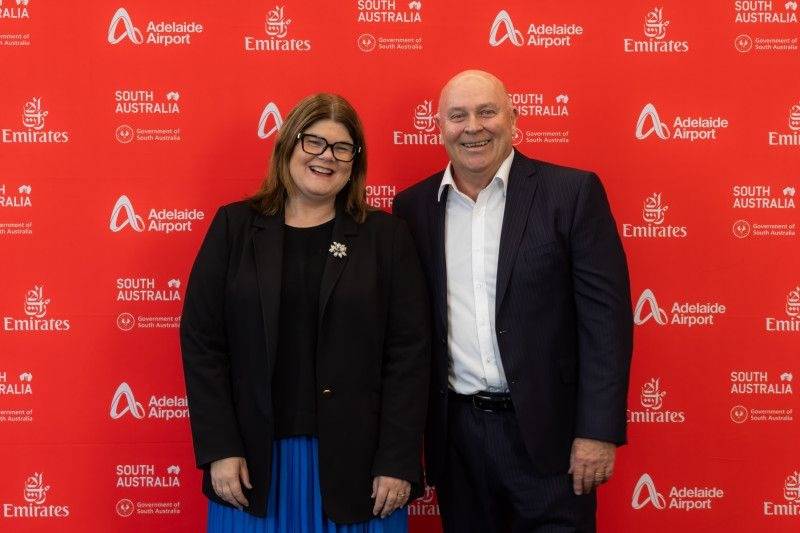
Emirates’ decision to base the long-range A350 in Adelaide was presented by the carrier as a strategic move that recognises Adelaide’s market potential and the city’s role within the airline’s global operation. Company representatives emphasised that Adelaide had been earmarked to receive the long-range variant in recognition of demand patterns and the city’s trade and tourism links. The aircraft’s arrival was overseen by Barry Brown, Divisional Vice President Australasia for Emirates; Zoe Bettison, South Australian Minister for Tourism; and Brenton Cox, Managing Director at Adelaide Airport, all of whom participated in the arrival ceremony.
New aircraft
Technically, the A350-900ULR that Emirates has brought to Adelaide is the long-range variant with a certified endurance that exceeds 14,000 km and the ability to remain aloft for up to 15 hours non-stop under appropriate operating conditions. Emirates positions the A350 as the most fuel-efficient large widebody aircraft in service and highlights its notably quiet twin-aisle cabin as a passenger comfort benefit. The carrier’s A350 configuration for Adelaide accommodates 298 passengers in total: 32 next-generation Business Class seats arranged 1-2-1, 28 Premium Economy seats in a 2-3-2 layout, and 238 Economy Class seats in a 3-3-3 configuration. This combination increases cabin choice for travellers while balancing capacity across classes.
In terms of inflight systems and passenger-facing features, the A350 brings a suite of technology and comfort improvements. Passengers will notice the airline’s next-generation ice inflight entertainment system, featuring ultra-responsive touchscreens with 4K and 4K HDR capability and new software functions such as the ability to skip credits or intros and an eye-comfort mode designed to reduce blue light exposure. The aircraft also offers multiple camera views, giving passengers external perspectives of the flight, and improved live map graphics. Connectivity has been upgraded too: the A350 is equipped with high-performance broadband via ViaSat’s Global Xpress network, together with enhanced Wireless Access Points that significantly raise the average total aircraft bandwidth available to customers.
Hardware enhancements include 60-watt USB-C charging at every seat, wireless charging in Business Class, Bluetooth pairing for personal headphones, and new aerBlade electric window blinds with a Ghaf tree motif in the premium cabins. Business Class features the so-called S Lounge seats, inspired by the Mercedes S Class, which offer lie-flat functionality and a dedicated mini bar for inflight snacks. Economy Class has been refreshed with lighter blue upholstery, bronze-toned armrests and a new six-way adjustable headrest across the cabin.
Premium cabin
Premium Economy is presented as a distinct intermediate cabin offering quiet luxury between Business and Economy, and its debut in Adelaide completes the cabin’s rollout across Emirates’ Australian network. The 28-seat Premium Economy cabin on the A350 features cream leather upholstery with wood-panel accents and offers a substantial 19.5-inch seat width alongside a 40-inch recline. Each seat has a 13.3-inch inflight entertainment screen, in-seat charging, Bluetooth connectivity and a wood-finished side cocktail table. Ergonomic touches include a six-way adjustable headrest and a footrest intended to improve posture and comfort on the long sector.
Culinary and service elements are also upgraded for Premium Economy customers. A welcome drink is served in fine glassware, meals draw on seasonal ingredients and are presented on Royal Doulton china with Robert Welch stainless-steel cutlery, and the beverage list extends to include selected wines available in Business Class, including the sparkling Chandon Vintage Brut 2017. Amenities are designed with sustainability in mind, with amenity kits made from recycled materials and blankets and pillows created specifically for Premium Economy using more sustainable processes and fabrics. Additional ground benefits include priority boarding, access to a dedicated check-in area at Dubai International Airport and a generous baggage allowance of up to 35kg.
Emirates underscores that Premium Economy has shown strong load factors on Australia routes since its introduction elsewhere and expects similarly positive demand in Adelaide for a cabin that combines aspirational touches with value relative to Business Class.
Trade links
Beyond passenger services, Emirates’ Adelaide operation carries substantial cargo capacity. Each daily flight between Dubai and Adelaide is able to carry approximately 16 tonnes of cargo, which equates to 224 tonnes of weekly capacity on the route. The cargo mix supports a diverse range of South Australian exports, notably wine, seafood such as fish and mussels, chilled meat, fresh fruit and vegetables, cut flowers, pharmaceuticals, cosmetics and fashion garments. Based on the carrier’s estimates, the annual value of freight exports facilitated by Emirates’ services to Adelaide is approximately $98 million.
When calculated alongside tourism and broader economic effects, Emirates estimates the total annual expenditure generated by its Adelaide flights at about $160 million. South Australian officials add that the airline’s daily non-stop services already generate more than $62 million in tourism expenditure in the state every year, a figure ministers say will be further bolstered by the presence of the longer-range A350 and the Premium Economy cabin.
SkyCargo’s operational reach is a further strategic advantage. Dubai’s location allows Emirates SkyCargo to access two-thirds of the world’s population within an eight-hour flight window, which the airline leverages to position Dubai as a major distribution and transhipment hub for pharmaceuticals, perishable foods, e-commerce consignments and heavier machinery and equipment. With the recently signed Comprehensive Economic Partnership Agreement between the UAE and Australia opening avenues for increased bilateral trade, Emirates states it is well placed to facilitate and accelerate trade flows, supported by a weekly Australian cargo capability in excess of 2,350 tonnes across its network.
Emirates in Australia
The Adelaide A350 introduction complements an already extensive Emirates presence in Australia. The airline currently operates 70 weekly return services across Sydney, Melbourne, Brisbane, Perth and Adelaide. In October prior to the Adelaide debut, Emirates deployed a retrofitted four-class A380 to Perth, which introduced Premium Economy to Western Australia and contributed to the carrier’s ambition of offering consistent product choice across the continent. The network position of Dubai International Airport provides Australian travellers with direct or single-stop access to more than 40 European destinations and a wide array of global connections, with minimal transit times and the services of a major international hub.
Emirates’ relationship with Australia extends beyond passenger and cargo services. The airline has declared investment of more than $230 million into a portfolio of sponsorships and partnerships within the country, spanning sport and the arts. High-profile partnerships include long-standing ties to the Australian Open tennis tournament, Collingwood Football Club and the Sydney Symphony Orchestra. In 2025 Emirates launched a Force for Good programme in Australia in partnership with the Australian Tennis Foundation, a social-impact initiative intended to increase access to tennis for disadvantaged children across the five cities served by the airline. The programme’s targets for 2025 included supporting over 2,000 disadvantaged children by year end and delivering more than 6,500 opportunities to play tennis across over 50 schools and community courts; the first Adelaide Force for Good activity commenced in November and was delivered by Tennis SA.
Operationally, the expanded next-generation fleet mix and cabin rollout are presented by Emirates as part of a long-term commitment to the Australian market, aimed at offering both leisure and business travellers greater choice, improved comfort and more efficient connections for onward journeys to Europe and beyond. The carrier emphasises that the combination of aircraft types across its Australian network is designed to match market demand, with the four-class A380 deployed where appropriate for high-capacity markets, the four-class Boeing 777 serving Melbourne, and the A350 offering an optimised long-range option for Adelaide.
The airline’s passenger product, cargo capability and local partnerships are collectively presented as a multi-faceted investment that supports trade, tourism and community engagement across the country. By completing the rollout of Premium Economy to all five Australian gateways and bringing the long-range A350 to Adelaide, Emirates signals its intent to maintain and deepen ties between the UAE and Australia through enhanced connectivity, improved on-board experience and expanded cargo services.