

Chinese firm to launch driverless robotaxi fleet in Dubai this month
Partnership with RTA to accelerate smart mobility ambitions
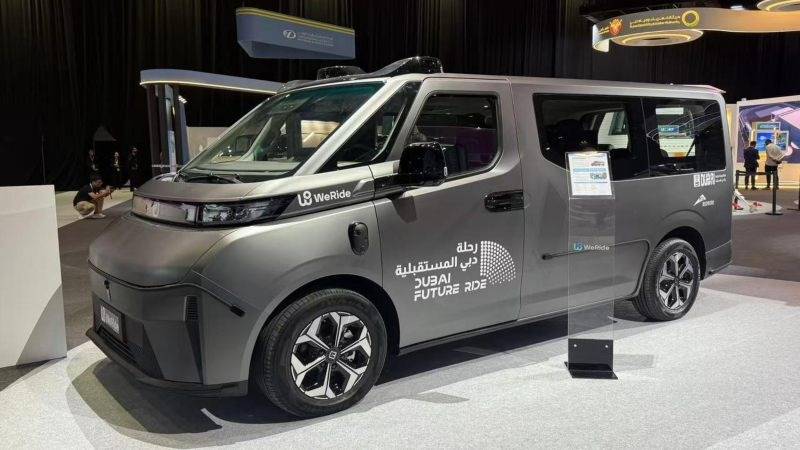
DUBAI – Dubai is set to take another decisive step towards autonomous mobility as Chinese self-driving technology company WeRide confirms it will launch fully driverless commercial robotaxi operations in the emirate this month.
The move comes in partnership with Dubai’s Roads and Transport Authority, marking a significant milestone in the city’s smart transport ambitions.
The rollout aligns with Dubai’s Self-Driving Transport Strategy, which aims to make 25 percent of all journeys in the emirate autonomous by 2030. Officials have repeatedly positioned Dubai at the forefront of large-scale driverless transport deployment, with robotaxis forming a central pillar of that strategy.
WeRide-RTA partnership
WeRide said it remains fully committed to supporting the objectives of the Roads and Transport Authority (RTA) as it expands its robotaxi footprint across the region. The company described Dubai as a leading global testbed for the commercialisation of fully driverless mobility solutions.
WeRide is fully committed to launch #driverless commercial #Robotaxi operations this month, in partnership with @rta_dubai. We remain steadfast in supporting Dubai’s Self-Driving Transport Strategy, which targets 25% autonomous journeys by 2030, as we expand Robotaxi operations… pic.twitter.com/jfLG2MyBIg
— WeRide.ai (@WeRide_ai) March 4, 2026
Following a recent unforeseen situation during trial operations, WeRide indicated that its test service is expected to resume within the coming days. The company stated that the development reflects both the resilience of its autonomous driving technology and continued regulatory confidence in the project’s progress.
Dubai’s ambition to integrate self-driving vehicles into daily transport stems partly from mounting traffic congestion and rising demand for ride-hailing services. Like other Gulf cities, the emirate relies heavily on migrant drivers for taxis and ride-hailing fleets, intensifying interest in automation as a long-term solution.
Regional expansion
The Gulf has increasingly become a prime overseas expansion market for Chinese autonomous driving firms. A supportive regulatory framework, strong consumer demand for app-based transport and government-backed smart city initiatives have created favourable conditions for deployment.
WeRide, which has operated in the Middle East since 2021, confirmed that its robotaxi fleets in Abu Dhabi and Riyadh continue regular public commercial passenger operations. The company said employees in the region are currently working from home and limiting unnecessary outings to ensure safety and wellbeing.
In January, the robotaxi unit of Baidu launched commercial driverless taxi services in Abu Dhabi, underlining intensifying competition among Chinese firms in the region. The Gulf has been widely viewed as a competitive arena where Chinese and US autonomous vehicle operators are vying for early dominance outside their domestic markets.
Speaking at the World New Energy Vehicle Congress in Abu Dhabi last week, a senior executive from WeRide welcomed the growing rivalry, describing active competition as positive for innovation and market development.
Ambitious targets
Across the region, governments have formalised autonomous transport targets as part of broader smart mobility plans. Dubai is aiming for 25 percent of daily journeys to be autonomous by 2030.
Abu Dhabi has set a similar benchmark, targeting 25 percent of total trips to be driverless by 2040. Meanwhile, Saudi Arabia has announced plans for 15 percent of journeys to be autonomous by 2030 as it advances its transport modernisation strategy.
Industry analysts view the Middle East as a strategic proving ground for robotaxi technology due to modern road infrastructure, high smartphone penetration and a population accustomed to ride-hailing services.