

Elettrica: Ferrari’s first all-electric supercar promises 530 km range
Battery, chassis and motors all developed in-house at Maranello

DUBAI – Italian automaker Ferrari has taken the wraps off the production-ready chassis and components of its first fully electric car, the Elettrica, during its Capital Markets Day 2025.
This long-anticipated vehicle marks the first ground step in the marque’s multi-energy strategy, now embracing internal combustion, hybrids, plug-in hybrids and full battery electric.
Ferrari emphasises that every major component has been developed in-house in Maranello: from the chassis and bodyshell to the electric motors, inverters, battery pack and control systems. The aim is to ensure the new model retains the performance, uniqueness and driving engagement that define a Ferrari.
Architecture and chassis
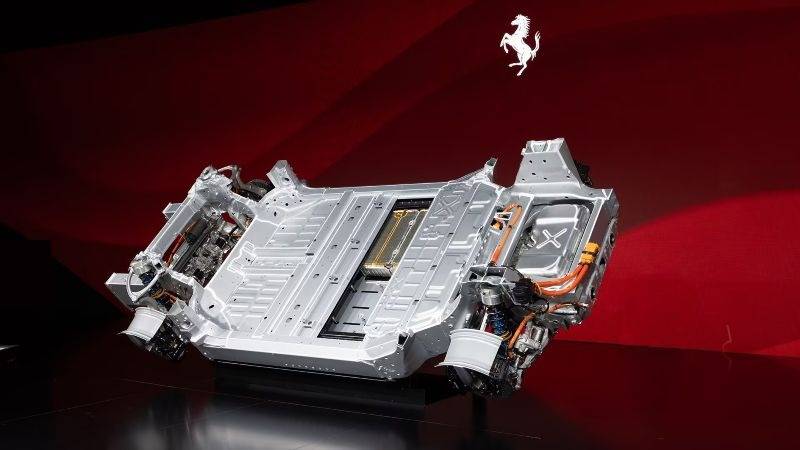
The layout features short overhangs, a driving position close to the front axle, and a battery pack fully integrated into the floorpan. The modules lie between the front and rear axles, with 85 % of the weight concentrated as low as possible, giving a centre of gravity about 80 mm lower than the equivalent internal combustion model. The bodyshell and chassis are built with 75 % recycled aluminium, resulting in a CO₂ saving of approximately 6.7 tonnes per car.
Ferrari has also introduced, for the first time, a separate rear subframe engineered to isolate noise and vibration while preserving dynamic stiffness. Its elastomeric bushes combine vertical and longitudinal flexibility with lateral stiffness, aiming to deliver comfort without compromising handling.
Crash safety is addressed via front shock towers that absorb impact energy directly, along with smart placement of the electric motors and inverter to dissipate forces before they reach structural nodes. The battery is protected within the chassis structure itself, with crumple zones, module spacing and lower cooling plates acting as safeguards.
Electric axles & motors
The Elettrica uses two e-axles, each with twin synchronous permanent magnet motors, following F1-derived Halbach rotor design. The front axle delivers up to 210 kW, with a power density of 3.23 kW/kg and 93 % peak efficiency, while the rear axle outputs 620 kW, with 4.8 kW/kg density and the same efficiency. Under full acceleration in Performance Launch mode, the rear axle can transmit up to 8,000 Nm to the wheels, while the front axle can achieve 3,500 Nm.
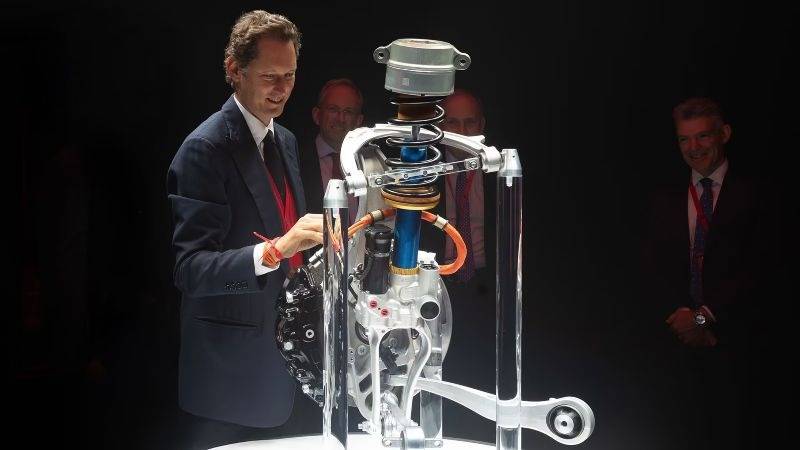
The front axle can also be decoupled at any speed, allowing the car to run in pure rear-wheel-drive for maximum efficiency, or engage all-wheel drive when conditions demand. The disconnect mechanism is 70 % lighter than prior systems and engages or disengages within 500 milliseconds.
Both axles incorporate lubrication via a dry sump integrated system, and all the power electronics and casting are produced in secondary aluminium alloys – cutting CO₂ emissions by as much as 90 % compared to conventional alloys.
Motor speeds reach 30,000 rpm in the front units and 25,500 rpm in the rear units, with angular acceleration up to 45,000 rpm/s. Carbon sleeves are press-fit to secure magnets against extreme centrifugal forces, with negligible weight penalty.
Battery system
Ferrari’s battery is a 15-module pack with 210 cells (14 per module plus additional upper modules) and a gross capacity of 122 kWh. It operates at about 800-880 V and is designed for fast charging at up to 350 kW. Energy density is claimed at nearly 195 Wh/kg, with cell energy density exceeding 305 Wh/kg in certain modules.
Eighty-five percent of the modules are housed under the floorpan, while the remainder is placed beneath the rear seat, enabling a compact wheelbase of 2,960 mm and optimal weight distribution of 47 % front / 53 % rear. The chassis and battery pack are structurally integrated: the battery shell becomes part of the vehicle’s stiffness.
Cooling is achieved via three cooling plates and internal piping, with uniform temperature control across modules, and all coolant flows feed into the main vehicle cooling system. The battery is serviceable and removable, allowing module or electronics replacement without damaging structural elements.
Inverter electronics are also fully integrated. The front inverter is built into the front axle, weighs just 9 kg, and delivers up to 300 kW. Ferrari’s “toggling” strategy is used on the rear inverter to switch between active and standby states, optimising efficiency and recovering around 10 km extra range under highway driving conditions.
Ferrari also deploys Order Noise Cancellation (ONC) software combining “Sound Injection” and a resonant controller to filter out undesirable currents and noise harmonics without degrading performance.
Driving modes, dynamics & sound
Three energy modes (Range, Tour, Performance) regulate power, energy flow and axle engagement, while on the steering wheel two controllers manage dynamics: the familiar Manettino on the right and a new eManettino on the left. The Manettino selects stability, traction and suspension settings (ICE, Wet, Dry, Sport, ESC-Off), while the eManettino configures energy usage, power limits, and whether the front axle participates (RWD vs AWD).
Pulling the right paddle cycles through five levels of torque and power delivery – a feature called Torque Shift Engagement (TSE) – in which transitions between levels feel smooth and nearly seamless. The left paddle adjusts regenerative braking levels to emulate engine braking in traditional driving.
Ferrari opted not to simulate engine sound. Instead, a high-precision accelerometer mounted on the rear inverter captures mechanical vibrations from the drivetrain. These signals are then amplified and projected to provide an authentic electric voice, audible only when dynamically meaningful. Under cruising, the system remains silent for acoustic comfort, but when accelerating or changing paddle settings, sound reactivates to cue the driver.
The third-generation 48 V active suspension system – evolved from the Purosangue and F80 applications – controls each wheel independently across vertical, longitudinal and lateral axes. A longer pitch ball screw improves vertical compliance, while the dampers incorporate thermocouples for fluid temperature monitoring. The override function is removed from the Manettino, decoupling suspension control from other dynamics settings.
Four-wheel steering, combined with torque vectoring on both axles and fully independent wheel control, allows Ferrari to claim the Elettrica can behave as if it were significantly lighter – even though the official mass is approximately 2,300 kg.
Performance figures and range
According to Ferrari, the Elettrica can accelerate from 0 to 100 km/h in 2.5 seconds, reach a top speed of 310 km/h, and in boost mode exceed 1,000 cv (horsepower equivalent). The estimated driving range is over 530 km on Ferrari-specified test conditions.
Dimensional specifications include a wheelbase of 2,960 mm, and the car carries an estimated curb weight of ca. 2,300 kg, with the aforementioned front/rear weight split of 47/53 %. No public figure for drag coefficient has been disclosed yet.
Ferrari will progressively reveal the exterior and interior design in early 2026, with the full world premiere scheduled for spring next year. This gradual unveiling follows its engineering reveal at Capital Markets Day, in which Ferrari also scaled back its EV targets: by 2030, only 20 % of its model line will be fully electric, with 40 % hybrid and 40 % internal combustion.
There is no official confirmed retail price from Ferrari as yet. However, according to reports, the first all-electric Ferrari is expected to cost at least €500,000 (≈ $535,000) before options.