

Air Arabia reports record Dh1.8bn pre-tax profit for 2025 as passengers hit 21.8 million
Dividend of 30 fils per share proposed

SHARJAH – Air Arabia has announced its strongest-ever financial and operational results, reporting a record pre-tax net profit of Dh1.8 billion for the year ended December 31, 2025, alongside double-digit growth in revenue, passenger traffic and network reach.
The Sharjah-based low-cost carrier also recorded a standout fourth quarter and proposed a cash dividend of 30 fils per share for shareholders.
The airline said full-year revenue rose to Dh7.78 billion, up 15% from Dh6.76 billion in 2024, supported by a sharp increase in passenger demand and continued network expansion across multiple markets. Total passengers carried across the group climbed 16% year-on-year to 21.8 million, while operational capacity grew by 10 percent.
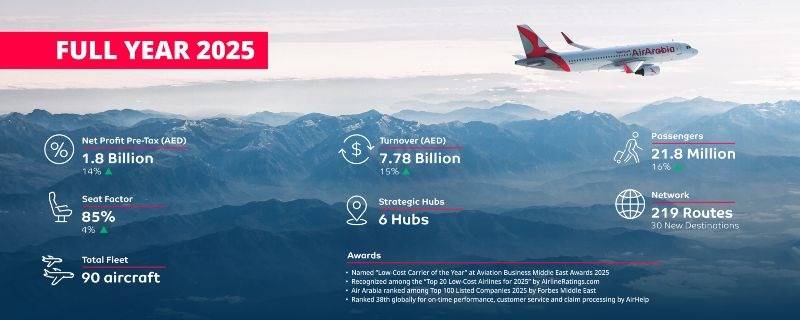
The performance marks a milestone for the Middle East and North Africa’s largest low-cost carrier operator, which now runs a multi-hub model spanning the UAE, Morocco, Egypt and Pakistan.
Profit and revenue
Air Arabia’s pre-tax net profit for 2025 reached Dh1.8 billion, reflecting a 14% increase compared to Dh1.6 billion recorded in 2024. The company attributed the rise to disciplined cost control, capacity optimisation and sustained travel demand across its network.
Turnover for the year crossed Dh7.78 billion, driven by higher passenger volumes and route additions. The average seat load factor improved to 85%, up four percentage points from the previous year, indicating stronger seat occupancy and route performance across the network.

In the fourth quarter alone, Air Arabia posted a net profit exceeding Dh405 million, up 15% from Dh351 million in the same period a year earlier. Quarterly turnover rose 26% to Dh2.12 billion. Passenger numbers during the quarter increased 22%, with more than 5.7 million travellers flying across all hubs. Seat load factor for the quarter reached 87%, up five percentage points year-on-year.

The airline’s Board of Directors has proposed a dividend distribution of 30% of share capital, equivalent to 30 fils per share. The proposal will be presented to shareholders for approval at the upcoming Annual General Meeting.
Leadership remarks
Sheikh Abdullah Bin Mohamed Al Thani, Chairman of Air Arabia, said the airline’s 2025 results reflect the strength of its low-cost business model and long-term growth strategy.
He stated that the carrier delivered its best performance since launch through disciplined execution, network expansion and operational efficiency, alongside continued customer demand for value-driven travel options.
He noted that the operating environment in 2025 included geopolitical tensions across the region as well as ongoing inflationary and supply chain pressures. Despite these factors, the airline maintained operational focus and flexibility while expanding its customer base and strengthening its position in key markets.
He added that the company continued investing in fleet and network growth to support its next phase of expansion and long-term shareholder value creation.
Network growth
Air Arabia added 30 new routes to its global network during 2025, expanding services across its operating hubs in the UAE, Morocco, Egypt and Pakistan. With these additions, the airline’s total network size reached 219 routes by the end of December.
The expanded route map supported higher aircraft utilisation and broader market coverage, contributing to the 10% increase in available capacity across the group. The multi-hub structure continued to serve as a core part of the airline’s growth model, allowing it to deploy aircraft efficiently and tap into diverse travel corridors.
Passenger demand remained strong across regional and international destinations, with the higher load factor reflecting route maturity and pricing discipline.
Fleet additions
Fleet expansion continued during the year with the addition of nine Airbus A320 family aircraft. These included five brand-new A320neo aircraft delivered under Air Arabia’s long-term Airbus order for 120 aircraft, along with four long-term leased A320ceo jets introduced to support network growth.
As of December 31, 2025, Air Arabia’s operating fleet stood at 90 Airbus A320 and A321 aircraft. This figure excludes five short-term leased aircraft used to meet peak seasonal demand across the group’s operations.
The entry of A320neo aircraft forms part of the airline’s fleet modernisation programme, aimed at improving fuel efficiency and lowering emissions while supporting capacity growth.
Liquidity and balance sheet
Air Arabia reported Dh5.3 billion in cash and cash equivalents at year-end, underlining its liquidity position and balance sheet strength. The airline said this provides flexibility to manage market volatility, fund fleet expansion and support future network development.
Management highlighted disciplined cost management and capital allocation as central to maintaining profitability while scaling operations across multiple jurisdictions.
Sustainability ratings
The airline maintained its MSCI ESG rating of “AA”, placing it in the global leader category among airlines on environmental, social and governance metrics. It was also assessed by S&P Global, receiving a sustainability score of 39 in 2025, up 14 points from the previous year.
Air Arabia welcomed its first Airbus A320neo during the year, with the aircraft type delivering up to 20% lower fuel burn and carbon dioxide emissions compared to previous generation models.
The group continues monitoring, reporting and verification of its carbon emissions and has published its Task Force on Climate-Related Financial Disclosures report. It also received its first CDP rating for its carbon dioxide reduction strategy and implementation, achieving a score of B-, placing it within the second-highest performance band.
Awards and rankings
Air Arabia and its affiliates received multiple industry recognitions in 2025 across performance, service and leadership categories.
The airline was named Low-Cost Carrier of the Year at the Aviation Business Middle East Awards 2025 and was also listed among the Top 20 Low-Cost Airlines for 2025 by AirlineRatings.com. It ranked among the Top 100 Listed Companies 2025 by Forbes Middle East.
AirHelp ranked Air Arabia 38th globally for on-time performance, customer service and claim processing. Group Chief Executive Officer Adel Al Ali was included among the 150 Most Influential Arabs 2025 by Arabian Business.
Fly Jinnah, the group’s Pakistani affiliate, was ranked second in punctuality by the Pakistan Civil Aviation Authority. The airline also received the Low-Cost Airline of the Year title at the TDM Travel Trade Excellence Awards 2025 for the Middle East.
Community projects
Air Arabia’s corporate social responsibility arm, Charity Cloud, continued delivering humanitarian and development projects across several countries during 2025. The initiative focuses on targeted, infrastructure-based interventions in underserved communities.
Projects completed during the year included the establishment of a kidney treatment centre in Egypt for patients requiring specialised medical care, and the opening of a new medical clinic in Bangladesh to expand healthcare access.
A sustainable water network project was implemented in Kyrgyzstan to provide safe and reliable access to clean water. The programme also supported the construction of four orphanages in Ethiopia, aimed at providing secure housing and facilities for vulnerable children.
These initiatives were carried out across multiple geographies with a focus on healthcare, water access and child welfare infrastructure.
Focus on growth
Looking ahead, the airline said it remains focused on strengthening its multi-hub operations, expanding its international network and increasing capacity in high-demand markets. Management also signalled continued emphasis on fleet utilisation, operational efficiency and customer engagement as part of its growth strategy.
The company highlighted its diversified hub structure, cost discipline and financial position as key factors supporting expansion plans in changing market conditions.