

From sturgeon to sky: Here’s how Emirates serves caviar in First Class
Unlimited service sees consumption rise more than 30 percent

DUBAI – From Persia to Poland, Emirates selects some of the finest Ossetra caviar for its First Class flyers, who are invited to savour unlimited servings of the delicacy onboard.
Demand continues to climb, with Emirates recording more than a 30 percent year-on-year increase in caviar consumption. The Dubai–London route sees the highest levels of caviar service, followed by flights to Paris, Sydney, Moscow and Bangkok.
To preserve the delicacy’s integrity, Emirates has created a signature ritual appreciated for its sense of reverence. Beyond the plate, the airline makes substantial investment in logistics, including a dedicated chauffeur drive to transport caviar to and from aircraft. Each flight is dispatched with its own supply, requiring around 165 cold-chain trips every day.
What makes caviar special?
Caviar has long held its place as one of the world’s most luxurious foods, valued for both rarity and flavour. Harvested from sturgeon roe, each bead offers a complexity of taste – delicate yet bold, briny yet buttery, melting smoothly on the tongue.
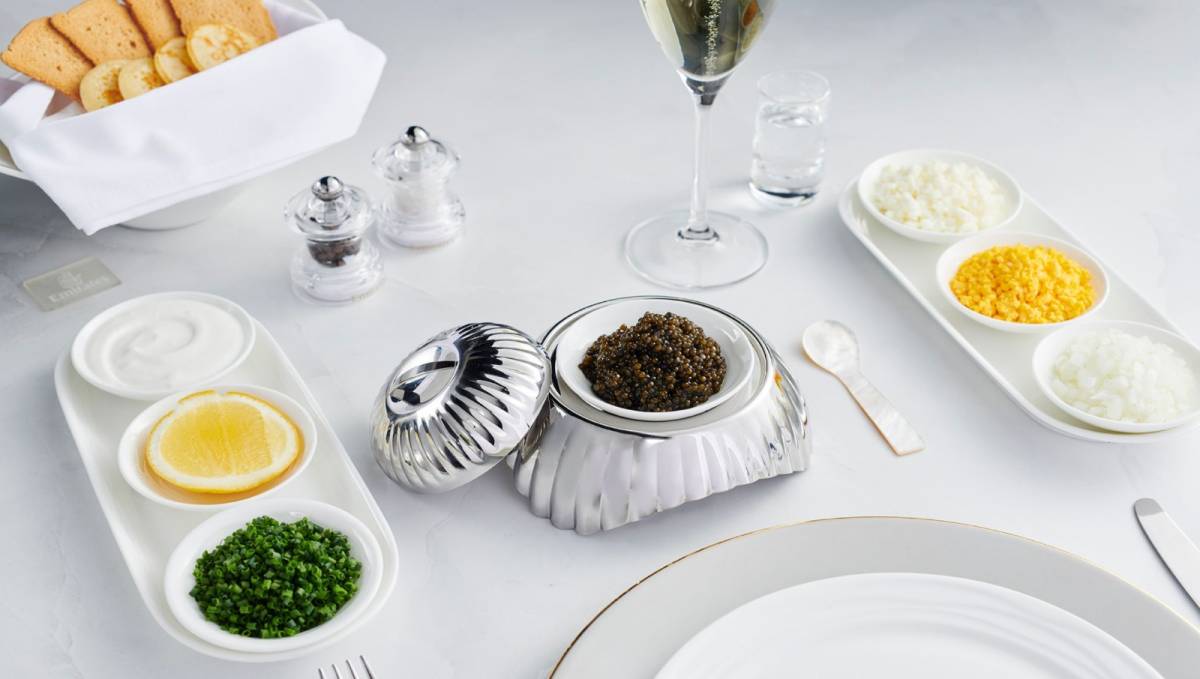
Onboard Emirates, this tradition transforms into a theatre of fine dining. First Class cabin crew begin by donning white gloves and setting a linen tablecloth. A curated array of accompaniments follows: melba toast, blinis, egg yolk and white, chives, white onions, sour cream and lemon. The centrepiece is then paired with Dom Pérignon champagne, which Emirates has exclusive rights to serve in the air worldwide. The champagne’s toasted brioche and almond notes complement the nutty, briny caviar, while its acidity balances the creamy texture.
In keeping with tradition, the caviar is served with a Mother of Pearl spoon to preserve the taste from metallic interference. Customers receive the delicacy in a presentation bowl engraved exclusively for Emirates, ceremoniously unveiled by cabin crew.
Where does Emirates’ caviar come from?
The caviar comes from Acipenser baerii, better known as the Siberian sturgeon. Native to the river systems feeding the Arctic Ocean – including the Ob, Lena and Yenisei in Siberia – this species is prized for its adaptability to aquaculture and its relatively fast maturation, producing roe in five to seven years. Growing up to two metres in length and weighing about 100 kg, Siberian sturgeon produce caviar with medium-sized beads ranging from dark grey to brown or black, offering a smooth texture and mild briny flavour.
Its qualities make it a cornerstone of the modern caviar industry, providing a high-quality, more responsible alternative to wild roe.
How is it prepared and delivered?
As the world’s largest provider of international First Class travel, with 26,800 seats available weekly, Emirates requires a significant volume of caviar. The production process is meticulous: roe is rinsed with water, lightly salted and chilled before reaching Emirates’ supplier. In Dubai, it is vacuum-sealed into ring-pull tins, pasteurised, cooled, and stored until delivery.
Three times a week, Emirates’ supplier delivers to the Emirates Flight Catering Facility in Dubai.
Transported in vehicles kept below 5°C, the caviar is then transferred by a dedicated Emirates chauffeur in a specialised vehicle to maintain perfect temperature before boarding. At overseas destinations, official caterers also receive caviar from Emirates’ supplier to uphold consistency across routes.
For every First Class flyer, the delicacy is available as a complimentary service, showcasing a journey of careful sourcing, preparation and presentation – from the sturgeon farms to the skies.