

Dubai’s intelligent road network achieves 96.65pc quality with proactive systems
Advanced monitoring tools detect damage before disruption occurs
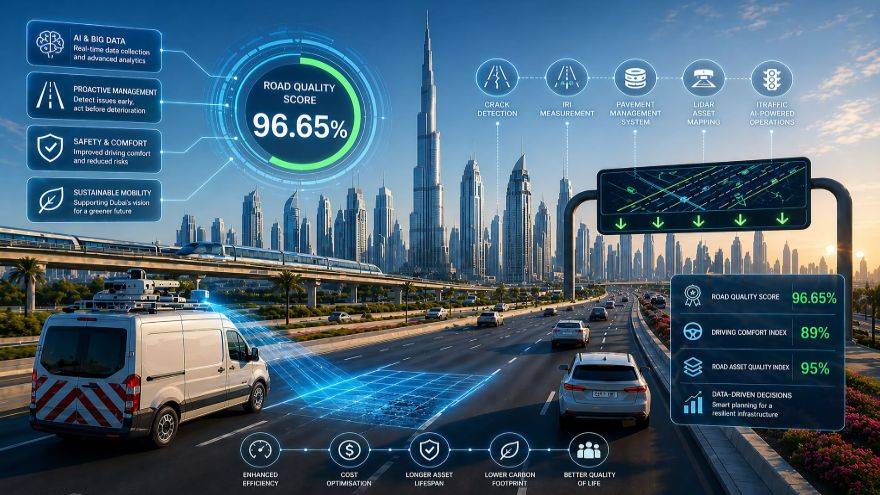
DUBAI – Dubai is advancing its road infrastructure through a proactive, technology-led approach powered by artificial intelligence and big data analytics, a shift that has positioned the emirate among global leaders in road quality with a performance score of 96.65 percent.
The initiative aligns with broader ambitions to enhance sustainable mobility while improving overall quality of life.
Take a closer look at the systems, technologies, and measurable outcomes driving this transformation.
AI-driven road monitoring systems
At the core of Dubai’s strategy is continuous, non-intrusive monitoring of road conditions. Advanced tools operate without disrupting traffic, enabling seamless data collection across the network.
Laser-based crack detection systems identify surface damage at an early stage, while specialised equipment calculates the International Roughness Index (IRI), a globally recognised measure of road smoothness. These technologies feed into a centralised Pavement Management System (PMS), which evaluates real-time data and determines precise maintenance requirements.
This proactive detection allows authorities to address issues before they escalate, reducing deterioration and avoiding major repairs.
Pavement Management System
The PMS plays a critical role in shifting from reactive to predictive infrastructure management. By analysing continuous data inputs, the system generates targeted maintenance schedules that prioritise high-risk areas.
This data-led planning improves operational efficiency and ensures that maintenance is carried out at optimal times. As a result, disruptions to traffic are minimised while extending the lifespan of road assets.
The system also supports long-term infrastructure planning by forecasting deterioration trends and aligning maintenance cycles with future demand.
Driving comfort and safety
The integration of smart technologies has translated into tangible improvements for road users. Early intervention reduces surface degradation, which in turn lowers vehicle vibrations and enhances overall driving conditions.
Dubai has recorded a driving comfort index of 89%, reflecting smoother journeys and improved ride quality. At the same time, addressing defects before they worsen has reduced safety risks associated with damaged road surfaces.
These enhancements contribute to better traffic flow and reduced congestion, reinforcing the efficiency of the wider transport network.
Big data framework
Dubai’s model is underpinned by the 5Vs of big data: volume, velocity, variety, veracity, and value. This framework enables authorities to process large volumes of diverse data in real time, ensuring accurate and actionable insights.
Through this approach, decision-makers can predict future road conditions, prioritise interventions, and allocate resources more effectively. The system supports both short-term fixes and long-term infrastructure strategies, ensuring resilience across the network.
This level of precision strengthens asset management and reduces unnecessary expenditure.
iTraffic system
Traffic management is further enhanced by the “iTraffic” system, an AI-powered platform that monitors and responds to road conditions in real time.
By analysing live data and forecasting movement patterns, the system enables immediate responses to congestion. Solutions are communicated to motorists through smart signage deployed across the emirate, helping to optimise routes and maintain steady traffic flow.
This dynamic approach ensures that traffic disruptions are addressed as they occur, improving journey times and network efficiency.
LiDAR technology
Dubai has extended its proactive approach to road assets through the use of LiDAR technology. This has enabled the creation of a highly detailed and accurate infrastructure database, capturing every element of the road network.
The data supports precise maintenance planning and reduces reliance on manual inspections. It also helps lower operational and emergency costs by identifying potential issues before they require urgent intervention.
As a result, the emirate has achieved a 95% score in the road asset quality index, reflecting the effectiveness of its asset management strategy.
The combination of AI, big data analytics, and advanced sensing technologies has established a comprehensive ecosystem for road management. Each system feeds into the other, creating a unified framework that enhances performance across monitoring, maintenance, and traffic operations. This integrated model ensures that infrastructure remains resilient, efficient, and aligned with sustainability goals.