

From sugar taxes to flying taxis: 12 new rules and projects coming to UAE in 2026
Transport and mobility innovations set to transform daily life in the emirates
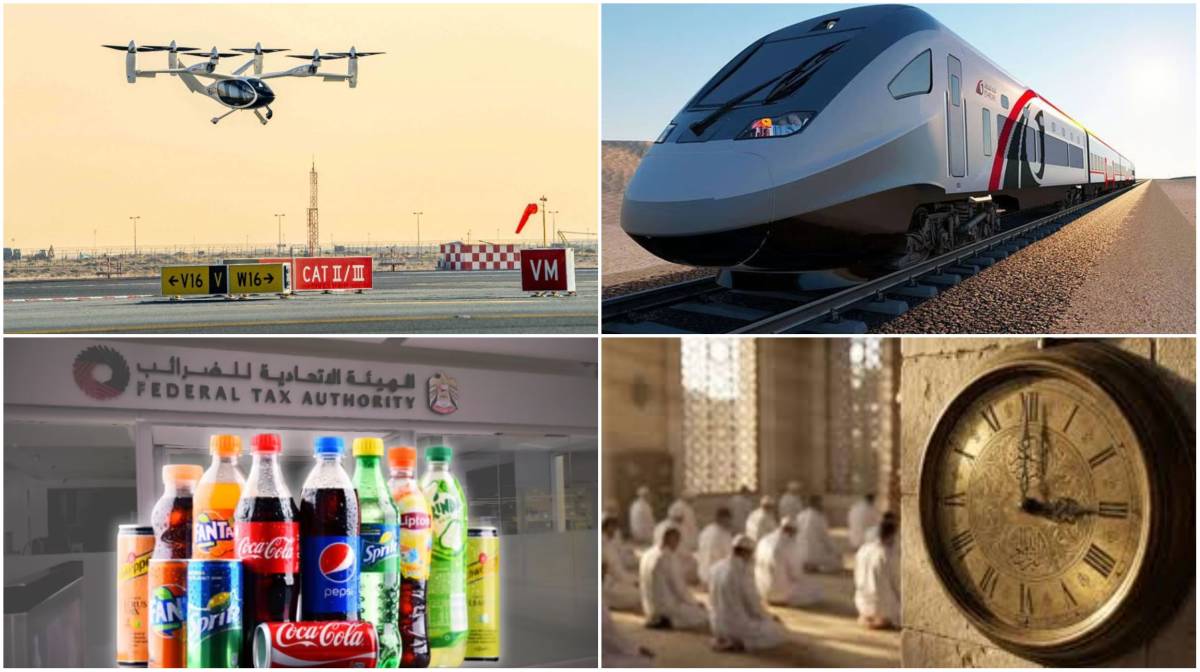
DUBAI – From sweeping environmental regulations to landmark transport launches and changes to school and prayer schedules, 2026 is shaping up to be a year of significant transition for the UAE.
Several new rules will take effect from the very first days of January, directly affecting how residents live, work, travel and do business. Alongside regulatory updates, ambitious national projects in mobility and space are set to move from planning to reality.
Together, these measures underline the country’s push towards sustainability, efficiency and future-ready infrastructure.
Single-use plastic tableware banned nationwide
From January 1, 2026, the UAE will expand its federal ban on single-use plastic products under Ministerial Decision No. 380 of 2022. The import, manufacture and trade of plastic plates, cutlery, beverage cups and lids, straws, stirrers and Styrofoam food containers will be prohibited across the country.
The move builds on earlier restrictions, including the ban on single-use plastic bags introduced in stages from 2024. Authorities say the expanded ban is aimed at cutting waste, protecting marine and land ecosystems and accelerating the shift towards a circular economy.
Dubai enters final phase of plastic restrictions
Alongside the federal ban, Dubai will implement the final phase of its own single-use plastic restrictions from January 1, 2026. This phase tightens controls on items such as plastic plates, cutlery, cups and lids.
Dubai Municipality has issued guidance to businesses on approved alternatives, following earlier bans on plastic bags, polystyrene containers, stirrers, cotton buds and straws rolled out between 2024 and 2025.
New sugar tax system for sweetened drinks
A revised excise tax structure for sugar-sweetened beverages will come into legal effect on January 1, 2026. The UAE will replace the current flat 50 per cent tax with a tiered, volumetric system based on sugar or sweetener content per litre.
Under the new model, drinks containing five grams but less than eight grams of sugar per litre will be taxed at 79 fils per litre, while beverages with eight grams or more will be taxed at Dh1.09 ($0.30) per litre. The update aligns the UAE with a wider GCC framework and is designed to more precisely reflect sugar content.
Friday prayer time standardised nationwide
From January 2, 2026, Friday sermon and prayer times will be standardised at 12.45pm across all mosques in the UAE. The decision follows a four-year study by the Authority of Islamic Affairs, Endowments and Zakat into the social impact of prayer timings.
The change comes after Friday became a working day for the public sector in 2022 and is intended to improve consistency and organisation nationwide.
Schools to end Fridays earlier
Changes to prayer timings will directly affect the education calendar. In Dubai, private schools and early childhood centres must end lessons by 11.30am on Fridays, effective from January 9, 2026.
The Knowledge and Human Development Authority said the adjustment ensures students and staff have adequate time before Friday prayers begin. The decision follows consultations with schools across the emirate and applies to all private education providers.
Paid parking introduced in Discovery Gardens
From January 15, 2026, regulated paid parking will be introduced across Discovery Gardens. Dubai Holding Community Management has confirmed the system will be operated by Parkonic, with signage installed ahead of the launch.
Each residential unit without an existing parking space will receive one complimentary permit, while households with additional vehicles will need to purchase paid subscriptions for extra cars.
Content creators face licence deadline
Content creators and influencers earning income from advertising must obtain an official Advertiser Licence by January 31, 2026. The licence, introduced by the UAE Media Council, regulates paid promotional activity across social media platforms.
The permit is valid for one year and renewable. It is free for the first three years for UAE citizens and residents. Applicants must be at least 18, have no prior media violations and hold a valid electronic media trade licence. Individuals promoting their own products and certain minors producing educational or cultural content are exempt.
Dubai Airport expands Red Carpet biometric service
Dubai International Airport is set to extend its Red Carpet biometric service to arriving passengers at Terminal 3 by early 2026. The service uses AI-powered cameras to match travellers’ biometric data with immigration records, allowing faster processing through smart corridors.
Passengers complete a one-time registration linking their passport and biometric profile, enabling quicker arrivals on future visits.
Etihad Rail passenger trains to launch
A nationwide passenger rail service is expected to begin operations in 2026. Etihad Rail’s high-speed trains, built by Spain’s CAF, will connect Abu Dhabi and Fujairah at speeds of up to 200km an hour, with each train carrying up to 400 passengers.
The network is projected to serve 36 million passengers annually by 2030, linking 11 cities and easing road congestion.
Flying taxis move closer to take-off
Both Dubai and Abu Dhabi are preparing to introduce piloted air taxi services. In Dubai, all-electric vertical take-off taxis developed with Joby Aviation have already completed test flights, with journeys from Dubai International Airport to Palm Jumeirah expected to take about 12 minutes.
Abu Dhabi plans to deploy Archer Aviation’s Midnight aircraft from up to 10 vertiports across key business and tourism hubs, pending final safety certification expected by late summer 2026.
Driverless taxis and deliveries expand
Autonomous vehicles will become increasingly visible in Abu Dhabi in 2026. Uber and WeRide have launched level-four driverless taxis serving Zayed International Airport and areas including Yas, Reem and Saadiyat islands, after completing more than 800,000km of incident-free testing.
Later in the year, a fleet of autonomous Mercedes S-Class taxis operated by UAE-based Lumo is expected to join the roads. Separately, driverless delivery vehicles developed by Auto Go will begin pilot operations with noon.com, with a long-term target of handling 25 per cent of deliveries by 2040.
UAE prepares for second lunar rover mission
Beyond Earth, the UAE is planning the launch of Rashid Rover 2 in 2026. Developed by the Mohammed bin Rashid Space Centre, the rover is scheduled to travel aboard Firefly Aerospace’s Blue Ghost Mission 2.
The rover is expected to reach the Moon around six weeks after launch and operate for one lunar day, equivalent to about two weeks on Earth, at a previously unexplored site on the far side of the Moon.