

Dubai mosques to feature EV charging as IACAD and UAEV unveil smart infrastructure project
Eight-year agreement strengthens sustainable transport integration within community spaces

DUBAI – The Islamic Affairs and Charitable Activities Department in Dubai (IACAD) has taken a notable step towards sustainable urban development through a new partnership with the Emarat EV Charging Stations Company (UAEV).
Under a framework agreement, electric vehicle charging infrastructure will be introduced across mosque parking areas in the Emirate, reflecting a forward-looking approach to community services.
The initiative is designed to combine religious, social and environmental objectives within a single integrated model. It also highlights the growing role of mosques as multifunctional community hubs aligned with modern infrastructure needs.
Strategic agreement
The agreement, signed in the presence of Ahmed Darwish Al Muhairi, Director General of IACAD, and Engineer Ahmed Al Kaabi, Board Member of UAEV, spans eight years with an option for renewal by mutual agreement. This long-term commitment ensures continuity and scalability of the project, allowing it to evolve alongside advancements in clean energy technologies and smart mobility solutions. The collaboration reflects a shared vision of embedding sustainable practices into everyday community environments.
Under the agreement, mosque parking areas across Dubai will be equipped with modern electric vehicle charging stations. These installations will be supported by comprehensive services, including routine maintenance, operational monitoring and secure smart payment systems. The infrastructure is also designed to incorporate advanced energy management technologies, aimed at improving efficiency while reducing environmental impact. This structured approach ensures both reliability and long-term sustainability.
Smart integration
A key feature of the project is the introduction of a dedicated digital application, enabling users to locate available charging stations with ease. This enhancement aims to streamline the user experience and encourage wider adoption of electric vehicles by making charging facilities more accessible to the public. By integrating digital tools, the initiative aligns with Dubai’s broader smart city vision and reinforces the role of technology in everyday services.
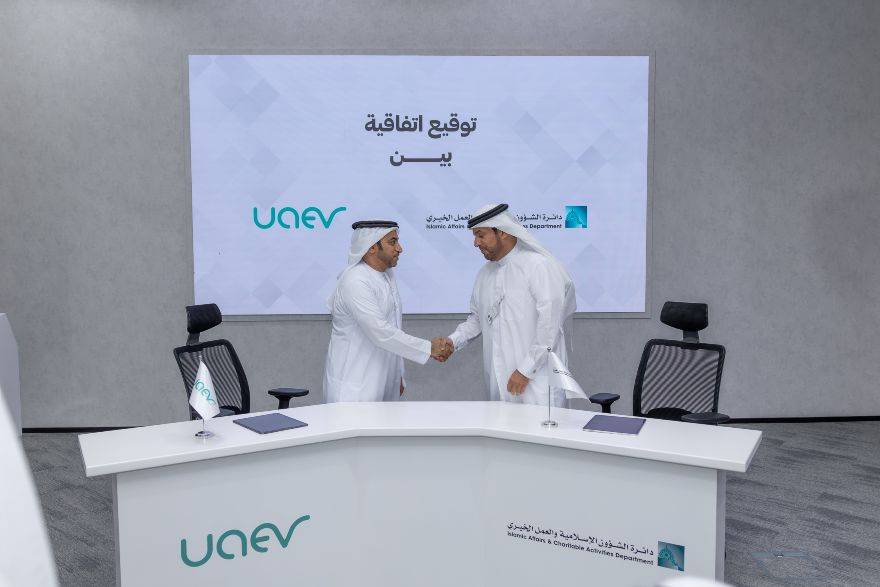
Ahmed Darwish Al Muhairi emphasised that the project represents a qualitative shift in how mosque-related services are developed and delivered. Rather than focusing solely on traditional functions, IACAD is moving towards a more comprehensive ecosystem that anticipates future community needs. He noted that integrating clean energy solutions within mosque facilities strengthens their position as active civic spaces contributing to sustainable development.
The initiative also aligns with national policies on energy transition, environmental stewardship and smart transformation. By embedding such technologies into religious and community infrastructure, the project sets a precedent for how public services can evolve in line with strategic sustainability goals.
Sustainable mobility
Engineer Ahmed Al Kaabi highlighted the importance of collaboration between institutions in advancing sustainable mobility across the UAE. He stated that integrating EV charging infrastructure within community-centric locations, such as mosques, plays a crucial role in supporting the country’s transition towards a low-emissions future. The partnership reflects a broader effort to make clean transport solutions more accessible to residents and visitors alike.
Ali Al Darwish, Acting Chief Executive Officer of UAEV, described the initiative as a practical step in expanding EV charging services across the country. He noted that the strategy focuses on delivering charging solutions in locations that are central to daily community life, ensuring accessibility while maintaining a clear expansion roadmap. The approach supports the steady growth of the national charging network.
Consultant Engineer Ali Al Halyan Al Suwaidi added that the project is built on advanced technical foundations, incorporating the latest EV charging technologies. The infrastructure adheres to stringent safety and operational efficiency standards, while also being designed for future scalability. It integrates smart energy management systems and performance monitoring tools, ensuring it can adapt to the rapid increase in electric vehicle usage across Dubai.
Through this initiative, IACAD reinforces its commitment to environmental sustainability and smart infrastructure development. The project not only enhances mosque facilities but also strengthens their role as forward-looking community centres aligned with the Emirate’s long-term vision for innovation and sustainable growth.