

Dubai International surpasses Atlanta to become world’s busiest airport
Exceptional demand drives record January passenger numbers at DXB

DUBAI – The Dubai International Airport (DXB) has officially claimed the top spot as the world’s busiest airport, surpassing Hartsfield-Jackson Atlanta International Airport (ATL) this month.
The latest rankings, based on total scheduled airline seat capacity, show Dubai handling 5.5 million seats for the month, ahead of Atlanta’s 4.9 million. Tokyo Haneda International Airport ranks third globally.
The milestone reflects Dubai’s growing influence as a global aviation hub, driven by strong tourism demand, a high volume of transit traffic, and continuous expansion of airline networks. DXB had already been among the world’s busiest airports in 2025, but this leap marks a new peak in its growth trajectory.
Strong passenger volumes
Dubai Airports reported record-breaking passenger traffic at the close of 2025, carrying momentum into 2026. In December alone, DXB processed approximately 8.8 million passengers, up from 8.3 million in December 2024, marking the busiest month in its history. Early January saw daily passenger numbers exceed 300,000, with January 3 recording 324,000 travellers – the airport’s highest single-day total ever—followed closely by 322,000 on January 4.

Paul Griffiths, CEO of Dubai Airports, described the demand during the current peak season as “exceptional.” He confirmed that DXB is forecast to welcome around 3.4 million passengers between January 1 and January 11, reflecting sustained growth in the first weeks of 2026. Griffiths credited the airport’s ability to manage high traffic to careful planning across airlines, service providers, and government entities, coordinated under the oneDXB partnership framework.
January peak
The OAG rankings consider scheduled airline seat capacity for both domestic and international flights, providing a forward-looking measure of airline confidence and expected passenger volumes. DXB’s increase to 5.5 million seats represents a 4% rise from January 2025. Atlanta, meanwhile, increased only 1% year-on-year, placing it at 4.92 million seats, while Tokyo Haneda recorded a slight 1% decline to 4.64 million.
Other airports in the top ten include Guangzhou Baiyun (4.43 million seats), Shanghai Pudong (4.29 million), Istanbul (4.28 million), London Heathrow (4.25 million), Delhi (4.22 million), Dallas Fort Worth (4.07 million), and Seoul Incheon (3.92 million).
Dubai – A global hub
DXB’s performance in December and early January underscores its role as a major international hub. Strong winter tourism, major events, and long-haul route expansion all contributed to record annual passenger traffic in 2025. The growth is expected to continue throughout 2026, highlighting the airport’s strategic importance for both the UAE and the broader aviation industry.
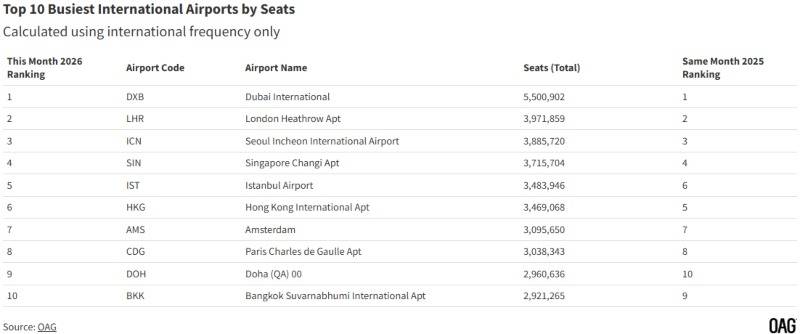
International seat capacity growth has also been notable. Istanbul Airport recorded a 6% increase to 4.28 million seats, London Heathrow remained broadly flat at 4.25 million, and Delhi grew 5% to 4.22 million seats. The data highlights varying trends across key markets, with airports like Singapore Changi and Shanghai Pudong seeing slight declines, while Doha and Hong Kong experienced strong growth.
Regional performance
In addition to topping the global charts, DXB remains the busiest international airport in the world. London Heathrow ranks second in international capacity with 3.97 million seats, followed by Seoul Incheon with 3.89 million. Istanbul Airport has grown rapidly among international hubs, with a 7% year-on-year increase to 3.48 million seats.
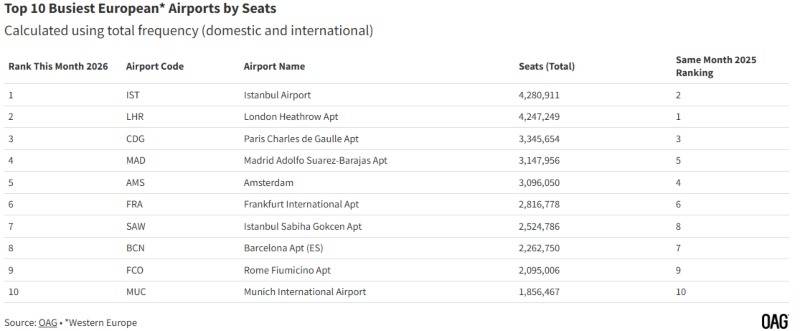
Europe’s busiest airport is Istanbul, followed by London Heathrow and Paris Charles de Gaulle, reflecting steady capacity growth across major European hubs. Other notable performers include Amsterdam Schiphol, Madrid Barajas, Frankfurt, and Istanbul Sabiha Gökçen, which recorded a 13% increase in seat capacity.
DXB travel tips
For travellers, Dubai Airports offers a range of facilities designed to streamline the airport experience. Emirates passengers can use early and self-check-in options, including city check-in services. flydubai passengers are advised to arrive at least four hours before departure. DUBZ provides home check-in and baggage collection services, allowing passengers to complete airport formalities remotely.
DXB Express Maps, a QR-based wayfinding platform, helps guests navigate terminals efficiently. Airlines encourage passengers to check baggage allowances in advance and to be prepared for security screening. Smart Gates for families with children over 12 allow faster passport control processing.