

Dubai International Airport crowned world’s busiest for international travellers in 2025
DXB handled 95.2 million passengers amid strong global travel demand
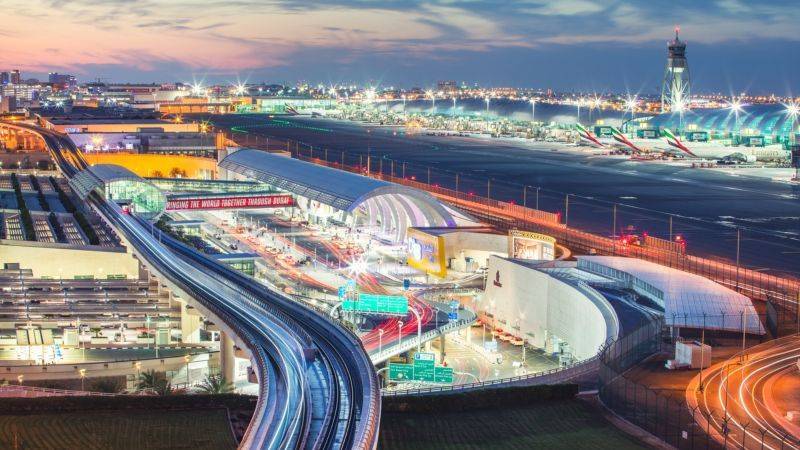
DUBAI – Dubai has once again cemented its status at the heart of global aviation, with Dubai International Airport emerging as the world’s busiest airport for international passenger traffic in 2025.
The latest rankings released by Airports Council International confirm the airport handled 95.2 million passengers over the year, underlining its dominance as a global transit hub.
The figures highlight Dubai’s enduring appeal as a key gateway linking East and West, even as global travel demand continues to evolve. The airport also secured second place worldwide for total passenger traffic, reinforcing its broader significance in international aviation networks.
Global ranking
According to ACI’s 2025 report, Hartsfield-Jackson Atlanta International Airport retained its position as the world’s busiest airport overall, handling 106.3 million passengers. Tokyo Haneda Airport followed in third place with 91.7 million passengers, reflecting a strong rebound across Asia-Pacific aviation markets.
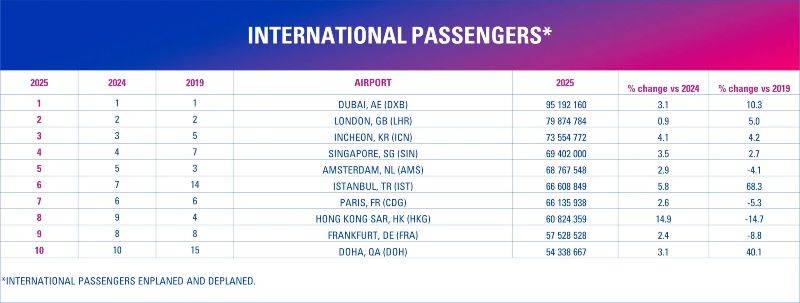
Despite ranking second in total passenger numbers, Dubai maintained its top position for international passenger traffic, ahead of London Heathrow Airport and Incheon International Airport, which held second and third positions respectively in that category.
ACI noted that the world’s top 10 busiest airports for total passenger traffic accounted for around 9 per cent of global traffic, illustrating the concentration of activity among major hubs.
Traffic trends
Globally, passenger numbers reached an estimated 9.8 billion in 2025, marking a 3.6 per cent increase compared to 2024 and a 7.3 per cent rise from pre-pandemic levels in 2019. International passenger traffic alone climbed to 4.0 billion, up 5.9 per cent year-on-year and 8.3 per cent higher than 2019 figures.
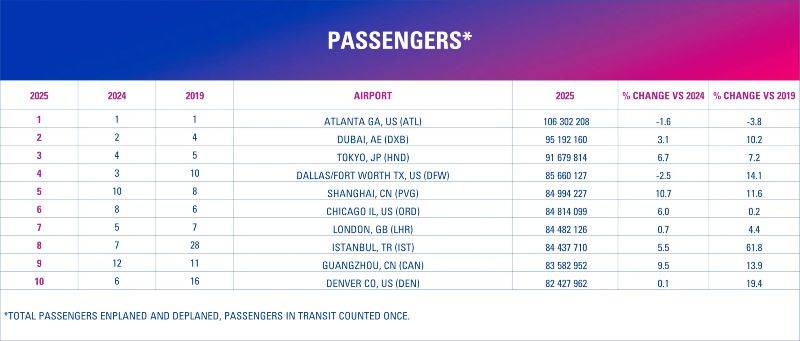
Growth was largely driven by international travel demand, with Asia-Pacific airports experiencing a notable resurgence. Airports such as Shanghai Pudong International Airport recorded significant gains, supported by policy easing and expanded connectivity, while Guangzhou Baiyun International Airport rebounded sharply in global rankings.
At the same time, North American and European hubs approached capacity limits, with infrastructure constraints and aircraft delivery delays emerging as key challenges for the industry.
Industry outlook
The global aviation sector in 2025 operated against a backdrop of steady but cautious economic growth, with global GDP expanding by approximately 3.0 to 3.2 per cent. Lower fuel prices, down around 13 per cent year-on-year, and easing inflation supported passenger demand, boosting travel volumes despite ongoing geopolitical uncertainties.
Airspace restrictions and regional conflicts continued to reshape flight routes, increasing travel times and operational costs while shifting traffic flows towards alternative hubs such as Dubai. The reopening of China’s outbound travel market further accelerated international traffic, benefiting major global airports.
Air cargo volumes also showed resilience, rising by 2.9 per cent year-on-year to nearly 128.9 million metric tonnes. Leading cargo hubs included Hong Kong International Airport and Shanghai Pudong International Airport, while Ted Stevens Anchorage International Airport climbed to third place, reflecting evolving supply chain dynamics driven by e-commerce demand.
Aircraft movements worldwide reached approximately 101.5 million in 2025, a modest increase of 2.3 per cent compared to the previous year. O'Hare International Airport ranked first globally for aircraft movements, followed by Atlanta and Dallas/Fort Worth, underscoring the operational intensity of major aviation hubs.
ACI Director General Justin Erbacci highlighted the growing complexity faced by airports managing rising demand, calling for sustained investment in infrastructure and aviation systems to support future growth.