

Dubai gold rates climb Dh13.25 in 24 hours as markets track US-Iran developments
Silver and platinum markets follow global precious metals shift
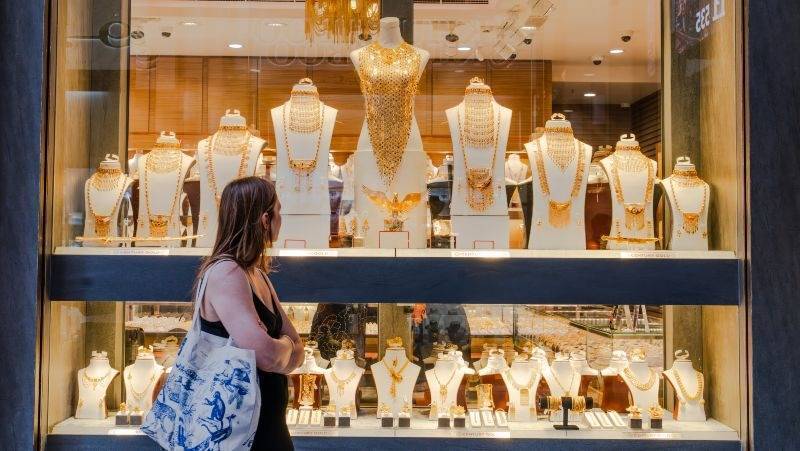
DUBAI – Dubai’s gold market remains closely watched by jewellery buyers and investors as prices continue to respond to global economic signals, currency movements and geopolitical developments.
The Dubai Jewellery Group’s suggested retail gold jewellery prices showed a sharp rise on Friday, after fluctuations in international bullion markets during the week.
Gold rates in Dubai are influenced by global spot prices, the US dollar and wider market sentiment, making daily movements a key focus for consumers.
Dubai gold rates
According to the Dubai Jewellery Group, 24K gold was priced at Dh505 per gram on Friday, up from Dh491.75 per gram on Thursday. The rate for 22K gold stood at Dh467.75 per gram, while 21K was listed at Dh448.50 per gram and 18K at Dh384.25 per gram. The 14K category reached Dh299.75 per gram.
Compared with previous days, Friday’s rates marked a strong increase after Thursday’s decline. On Wednesday, 24K gold was priced at Dh506.50 per gram, 22K at Dh469, 21K at Dh449.75, 18K at Dh385.50 and 14K at Dh300.75. On Tuesday, 24K gold stood higher at Dh522.25 per gram, with 22K at Dh483.50, 21K at Dh463.50, 18K at Dh397.25 and 14K at Dh310. Monday’s rates were slightly lower than Tuesday, with 24K at Dh519.75 per gram and 22K at Dh481.25 per gram.
Global market
International gold prices fell on Friday and remained on track for a weekly decline as markets assessed inflation concerns and the possibility of higher US interest rates. Spot gold was down 0.5% at $4,193.58 per ounce as of 0442 GMT and was heading towards a weekly loss of about 3.1%. US gold futures for August delivery rose 2.5% to $4,215.30.
Gold prices were affected by shifting expectations around US monetary policy, with traders pricing in a 60% chance of a US rate hike in December, according to the CME Group’s FedWatch tool. Higher interest rates can reduce the appeal of non-yielding assets such as gold.
Geopolitical developments also remained a major factor for markets. US President Donald Trump said the United States and Iran could sign a peace agreement as soon as the weekend, with the possibility of reopening the Strait of Hormuz for shipping. Iran, however, indicated that no final agreement had been reached.
The conflict in the Middle East had pushed energy prices higher, raising concerns that inflation pressures could remain elevated and influence central bank decisions. Gold has declined around 20% since the Iran war began, reflecting changing investor expectations.
Dollar and oil
The US dollar and oil markets continued to shape precious metals sentiment. Rising energy costs linked to Middle East tensions contributed to higher US producer prices in May, recording the largest annual increase in three and a half years.
The world’s largest gold-backed exchange-traded fund, SPDR Gold Trust, reduced its holdings by about 0.3% to 923.89 metric tonnes on Wednesday. Meanwhile, ANZ lowered its year-end gold price target by $400 to $5,200 amid recent market volatility.
Other precious metals
Silver prices also moved lower, with spot silver falling 0.5% to $67.03 per ounce and remaining on track for a weekly loss. Platinum gained 0.7% to $1,731.41 per ounce, while palladium climbed 1.8% to $1,292.20, gaining about 5% over the week so far.