

Air Arabia Q1 profit falls 22pc to Dh278 million amid regional disruptions
Passenger demand remained resilient across the UAE carrier’s operating network
ABU DHABI – UAE airline Air Arabia has reported a net profit of Dh278 million for the first quarter ending March 31, 2026, as regional conflict and operational disruptions weighed on performance during the opening months of the year.
The budget carrier recorded a 22 percent decline compared with the Dh355 million reported during the same period last year. The airline attributed the decrease to ongoing conflict in the region, which led to airspace closures and temporary restrictions that sharply reduced operating capacity.
The airline, however, still posted a turnover of Dh1.8 billion during the first quarter of 2026, representing a 1 per cent increase compared with the corresponding quarter in 2025.
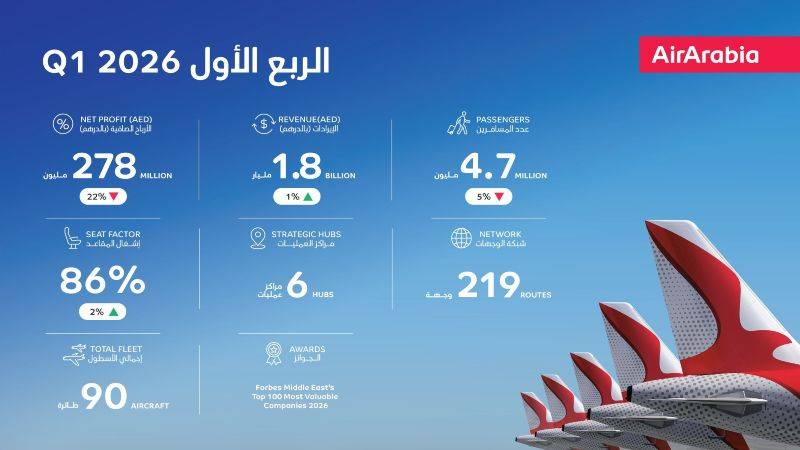
First Quarter 2026 Performance:
| Q1 2026 | Q1 2025 | % | |
| Revenue | AED 1.8 billion | AED 1.779 billion | 1% |
| Passenger Numbers*all hubs* | 4.7 million | 4.9 million | (5%) |
| Seat load Factor | 86% | 84% | 2% |
| Net Profit | AED 278 million | AED 355 million | (22%) |
Demand holds
Air Arabia carried 4.7 million passengers across its operating hubs during the first quarter, marking a 5 percent decrease year-on-year. At the same time, average seat load factor, which measures passengers carried as a percentage of available seats, rose to 86 percent, an increase of two percentage points compared with the same period last year.
The increase in revenue and seat load factor reflected continued strong demand for Air Arabia services during the quarter, despite operational disruption and lower flight capacity in March.
Commenting on the results, Sheikh Abdullah Bin Mohammad Al Thani, Chairman of Air Arabia, said the airline had demonstrated resilience and agility despite a difficult operating environment.
“Despite a challenging first quarter of the year, marked by airspace restrictions and operational disruptions as a result of the conflict in the region, Air Arabia demonstrated strong resilience and agility in responding to rapidly evolving conditions. Our ability to optimise capacity and maintain operational continuity enabled us to effectively manage the impact during this ongoing critical period,” he said.
He added that the carrier remained encouraged by strong passenger demand across markets where it continued operations.
“Despite these challenges, we are pleased to have delivered a solid first-quarter performance, supported by continued strong passenger demand across our network wherever we operated. This reflects the strength of our multi-hub business model, our disciplined cost management, and our ongoing focus on operational efficiency and service excellence,” Al Thani said.
Air Arabia network
During the first quarter of 2026, Air Arabia operated a fleet of 90 owned and leased Airbus A320 and A321 aircraft across its hubs in the UAE, Morocco, Egypt and Pakistan. Additional aircraft are expected to join the fleet during the year as part of the airline’s existing Airbus order book.
In February, Air Arabia was recognised among Forbes Middle East’s Top 100 Most Valuable Companies 2026, highlighting the carrier’s continued financial and operational strength.
The airline also continued progress on environmental, social and governance standards by obtaining a Limited Assurance Statement on its 2025 ESG Report under International Standard on Assurance Engagements (ISAE) 3000, reinforcing commitments to transparency, accountability and sustainable long-term growth.
Looking ahead, the airline said continued uncertainty across regional and global markets could add pressure through fuel price volatility, inflationary costs and ongoing supply chain disruptions.