

UAE Commemoration Day explained: History, traditions and national significance
It’s the day that honours those who gave their lives for the nation

DUBAI – Every year on 30 November, the United Arab Emirates pauses to observe a solemn occasion dedicated to remembrance, reflection, and national pride: Commemoration Day.
It is a day that pays tribute to Emirati martyrs who lost their lives in military, civil, and humanitarian service.
Although it falls just ahead of the UAE National Day, Commemoration Day is an occasion in its own right, grounded in history and rich in meaning. It symbolises values of loyalty, courage, sacrifice, and unity that are deeply woven into the UAE’s identity as a nation.
What is Commemoration Day?
First declared in 2015 through a decree by the late President Sheikh Khalifa bin Zayed Al Nahyan, Commemoration Day was established as a lasting national tribute. It honours Emiratis who sacrificed their lives defending the country and supporting humanitarian missions both at home and abroad. It serves not only as a moment of remembrance but also as a unifying national promise that their contributions will never be forgotten.
The date, 30 November, carries historical significance. It marks the passing of Salem Suhail bin Khamis Al Dahmani, considered the UAE’s first martyr. In 1971, at the age of 20, he was stationed on the island of Greater Tunb when foreign forces attempted to occupy it. He refused to lower the Ras Al Khaimah flag, defending it until his final breath. His legacy became a symbol of patriotic sacrifice just two days before the formation of the UAE.
How is it observed?
Official protocols guide the observance across government institutions and communities. According to the 2025 protocol, flags are lowered from 8am to 11.30am, followed by a minute of silent prayer that ends at 11.31am. Immediately after, the UAE flag is raised once again, and the national anthem Ishy Bilady is played, marking a moment of unity and reverence across the Emirates. Residents gather at spots where flags are hoisted, paying silent tribute to martyrs and their families.
Where is the Main Memorial?
The centre of national ceremonies is Wahat Al Karama, or Oasis of Dignity, in Abu Dhabi. Unveiled on Commemoration Day in 2016, and located opposite Sheikh Zayed Grand Mosque, it spans 46,000 square metres. Designed by British artist Idris Khan, its centrepiece is The Memorial, formed of 31 leaning aluminium-clad tablets that symbolise the solidarity between the nation’s leadership and its people. Engraved on these are poems and quotes, while the Pavilion of Honour displays the names of Emirati martyrs on aluminium panels made from armoured vehicles. The names date back to 1971 and include Salem Suhail bin Khamis.
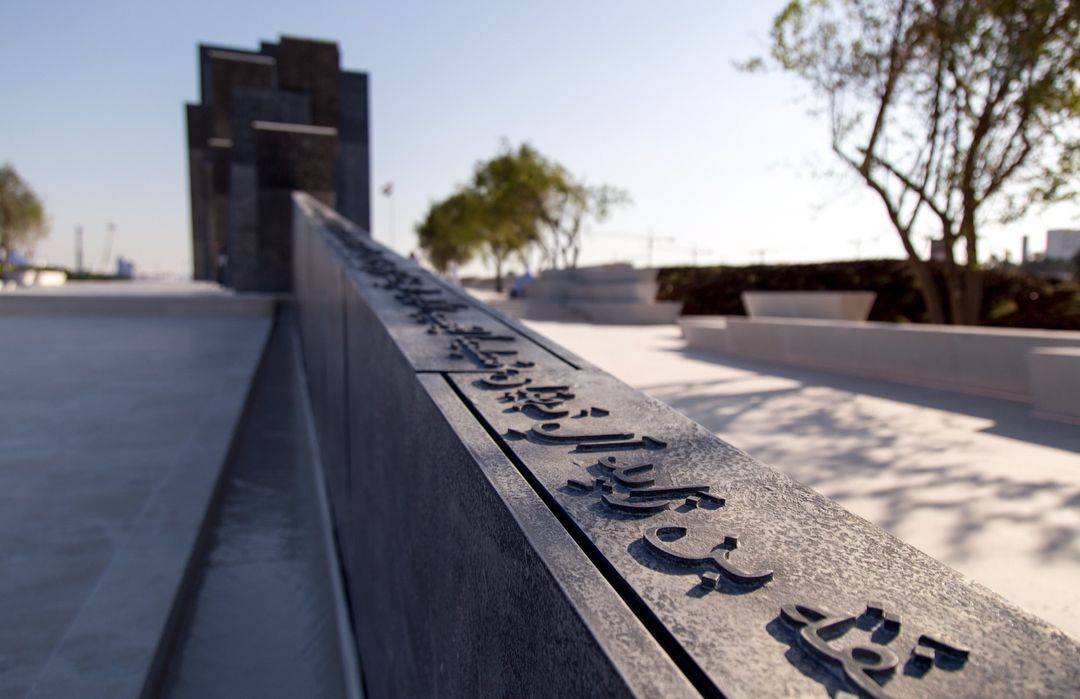
The Memorial Plaza, paved with travertine stone, features amphitheatre-style seating for around 1,200 people and a reflective pool mirroring both the monument and the Grand Mosque. It forms a powerful visual and emotional tribute to sacrifice.
Is it a public holiday?
For many, the question arises: is it a public holiday? In 2025, Commemoration Day falls on Sunday, naturally part of the weekend. It is not officially listed among the designated public holidays in the national calendar. However, it lands just before the UAE National Day holidays on Monday, 1 December, and Tuesday, 2 December, giving residents a four-day break. But the essence of Commemoration Day extends far beyond time off work.